

Fully online enrollment jumped 10% between fall 2022 and fall 2024, an increase of more than 400,000 students across all levels. But that growth is not evenly distributed. Enrollment in some states is surging, as others are quietly losing ground.
For colleges aiming to expand online enrollment, the first step is always to look locally. But increasingly, local markets have become porous, many “losing” students to institutions in other states.
NC-SARA data reveals who else may be recruiting in your backyard, and an understanding of this can provide the foundation for your growth strategy. Which institutions have large online market share in your state, and what should your institution do to combat it?
Online enrollment scale largely follows a state’s population, but a few key players have led the way in upending this rule of thumb. To understand online enrollment state-by-state, we have to begin with the largest providers, including Western Governors University (WGU), Southern New Hampshire University (SNHU), and University of Phoenix, which have dominated online enrollment since fall 2016. To illustrate, while online enrollment grew 10% between 2022 and 2024, WGU grew 33% — from 161,000 to nearly 215,000 students.
These online giants are the primary online competitors known for attracting students nationwide, but what is less understood is how their enrollment is drawn unevenly, coming from certain states more than others.
Enter NC-SARA
Although it has its limitations, NC-SARA enrollment data is valuable because it shows student enrollment by the student’s state of residence, unlike IPEDS, which reports by the institution’s state. Figure 1 shows each state’s total online enrollment in 2024, as represented by the size of each bubble.
Texas, Florida, and Georgia lead in terms of enrollment scale (notably, California, the largest state overall, does not participate in NC-SARA.) The Figure also shows that 14 of the largest states exceeded the national online enrollment growth benchmark of 10%. The three states with the largest online enrollment growth include Indiana (+37%), Georgia (+34%), and South Carolina (+24%)—perhaps not the ones you would expect.
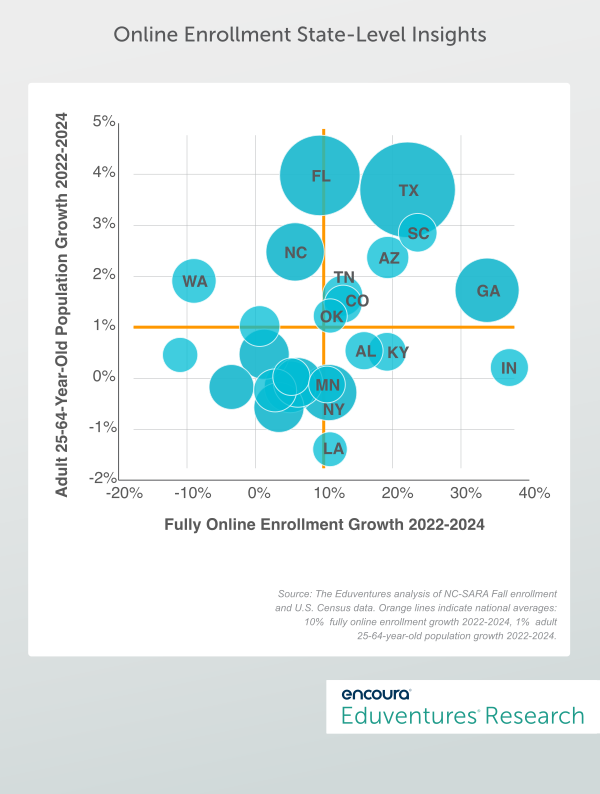
Figure 1.
States with larger population growth (25-64-year-olds) should, in theory, have better online enrollment. The national population growth between 2022 and 2024 was 1%, but only 10 of the largest 25 grew faster than that. Of those largest states, Florida (4%), Texas (3.7%), and South Carolina (2.9%) saw the highest population increases. Both total population size and growth appear to influence online enrollment scale.
Figure 1 reveals a striking pattern: Online enrollment growth often outpaces population growth, indicating that online education is reshaping how states’ residents access higher education rather than simply mirroring demographics. But let us take a closer look to see what could be driving online enrollment growth in these states.
Key State Findings
- Texas, the largest state, lacks a flagship online institution. Most major online providers are community colleges that offer bachelor’s degrees, such as Dallas College. But WGU draws 12% of its total enrollment from Texas, the most by far. The largest “true” four-year online providers are the University of Texas at Arlington and Lamar University, both growing through partnerships with online program management (OPM) firms. The absence of a flagship online leader leaves Texas institutions vulnerable to national providers with scale and brand recognition.
- Florida, the fastest-growing state, saw 9% enrollment growth. Like Texas, its online market is dominated by public two- and four-year institutions. A notable exception is Full Sail University, a private for-profit enrolling 22% of its roughly 37,000 students from Florida, despite its niche in entertainment, media, and technology. The University of Florida Online, a counterpart to the on-campus undergraduate program, enrolls 71% of its students from Florida. Larger state institutions like the University of Central Florida and Florida International University, with less restrictive admissions, enroll 94% of their online students from the state. Florida demonstrates how scale plus public-sector coordination can retain online students in-state.
- Georgia institutions have been late to enter the online market and are working to catch up; the University System of Georgia eCampus is expanding the state’s online presence. Five of the 10 largest institutions enrolling Georgia students, however, are out-of-state online giants. Georgia Tech, often lauded for its innovative and affordable master’s programs, enrolls just 20% from inside the state, suggesting that prestige is optimal for a national (and international) audience. Prestige travels well online, but it does little to protect a state from enrollment leakage without broad-access options.
- South Carolina has half of its state’s online enrollment at out-of-state institutions. The University of South Carolina Columbia (USC) is the largest in-state provider with 6,567 students and doubled its enrollment between 2022 and 2024. USC, however, accounts for only 8% of the state’s total online enrollment, highlighting that many students choose out-of-state options. Even fast-growing institutions can lose the market when local capacity fails to meet demand.
- Indiana experienced the largest online enrollment growth despite having a nearly flat working-age population (0.2%). While Purdue University Global is based in Indiana, Ivy Tech Community College had the largest online enrollment with 13,260 students. While WGU is often among the top institutions in any state, it is especially dominant as it enrolls 8% of all Indiana enrollment. This strength is due to Indiana being the first state to partner with WGU in 2010. Early policy decisions can lock in competitive advantages for decades.
These states each have their own stories and different challenges and opportunities for online enrollment growth. But knowing the size of your state’s online student population, its growth, and where they are enrolling is vital competitive intelligence.
The Bottom Line
The data reveals an uncomfortable truth: Most states are losing market share to a few national players that compete on scale, speed, and student experience—not on geography or reputation.
For regional and state institutions seeking growth, competitive intelligence is now a strategic necessity. Institutions that want to retain or grow local online students must:
- Use NC-SARA data to reveal out-of-state institutions that are primary competitors.
- Identify competitive programs and determine if they are losing or gaining ground.
- Differentiate through strong state employer partnerships, aligned workforce programs, seamless transfer pathways from community colleges, and hybrid offerings that balance proximity with flexibility.
Online education may be borderless, but enrollment losses are local. Institutions that fail to understand their competitive environments risk ceding their own students — state by state — to competitors who already understand the terrain.

