

Each December, we ask our analysts to reflect on the past year and share one insight that truly stood out. In Part I, we examined three takeaways from the traditional student demand landscape. This week, we’ll explore the increasing student demand in the non-degree market, and the impact AI is having on bachelor’s programs.
Who will ride the undergraduate certificate wave?
By: Richard Garrett
This year I learned that the undergraduate non-degree market is breaking records (and “Workforce Pell” is going to shake things up).
It took until 2022 for undergraduate certificates (for-credit) to surpass the conferral peak after the Great Recession, but over 1.2 million of these affordable alternatives to the embattled bachelor’s degree were awarded in 2024, 16% more than the previous high. Figure 1 compares undergraduate certificate conferrals and bachelor’s degree conferrals.
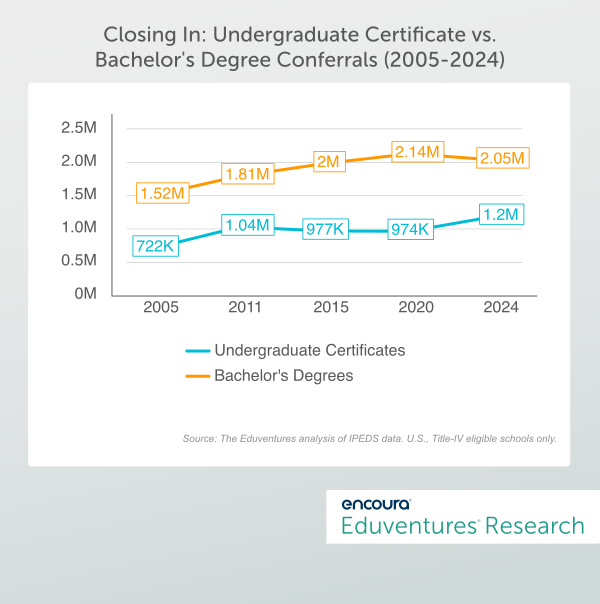
Figure 1.
In 2020, undergraduate certificate conferrals were 45% of the bachelor's degree total. By 2024, the gap narrowed to 59%. Bachelor’s conferrals have started falling, playing up the notion that the bachelor’s market is over-built.
Federal policy favors non-degree. “Workforce Pell” is coming in 2026, offering federal student aid for non-degree programs as short as eight weeks (the current threshold is 16 weeks), and promising a big boost to the undergraduate non-degree market. But which schools will benefit?
There are innumerable non-degree providers (that awarded 23% of undergraduate certificates in 2024), but only accredited providers are eligible, and programs must have been running for at least a year. There are over 600 fewer accredited non-degree, Title IV-eligible institutions than a decade ago. Program economics is challenging (narrow program range, rapid student turnover, low revenue-per-student), and it will take time for accreditors and novel providers to ramp up.
Might four-year schools benefit from “Workforce Pell?” These schools awarded over a quarter of undergraduate certificates (vs. 7% in 2010).
Four-year schools can design non-degree programs — quickly fashioned from existing degree courses — with optional on-ramps to bachelor’s degrees to sustain the core business. This can address student anxiety about degree relevance and value.
The catch is that “Workforce Pell” requires 70%-plus completion and job placement, and programs must lead to good salaries. Four-year schools may need to choose between supporting their degree businesses and offering high-value, non-degree programs in their own right.
Rather than disruptive non-degree providers or defensive four-year institutions, two-year schools may win out. These schools awarded half of undergraduate certificates in 2024 and may be a “safe bet” for policymakers and students. “Workforce Pell” might revive total two-year enrollment (down by a third over the past decade).
Student non-degree demand is growing, and federal aid is opening up, but providers — four-year, two-year, and non-degree alike — must get strategic to take advantage.
AI’s Uneven Impact Across Programs
What I learned in 2025 is that AI’s reach across bachelor’s programs will be universal, but the depth of its impact will vary widely.
AI is already reshaping the labor market — 31,000 out of 153,000 total layoffs in October 2025 cited AI as a contributing factor. As AI’s disruption accelerates, prospective students are questioning the value of a bachelor’s degree. But AI’s impact is uneven: some fields may shrink while others gain efficiency or evolve in new directions.
Understanding these differences is key to articulating program value and preparing students for an AI-driven workforce.
The AI Program Risk Metric
To quantify these differences, Eduventures has adopted an AI Program Risk metric, which estimates the likelihood that occupations aligned to a given program will be automated by AI or related digital tools.
The median AI Program Risk score for all bachelor’s programs is 50. Higher scores indicate greater risk of AI-driven automation, while lower scores indicate more insulation. Figure 1 shows the scores of several popular programs and how they compare to the median.
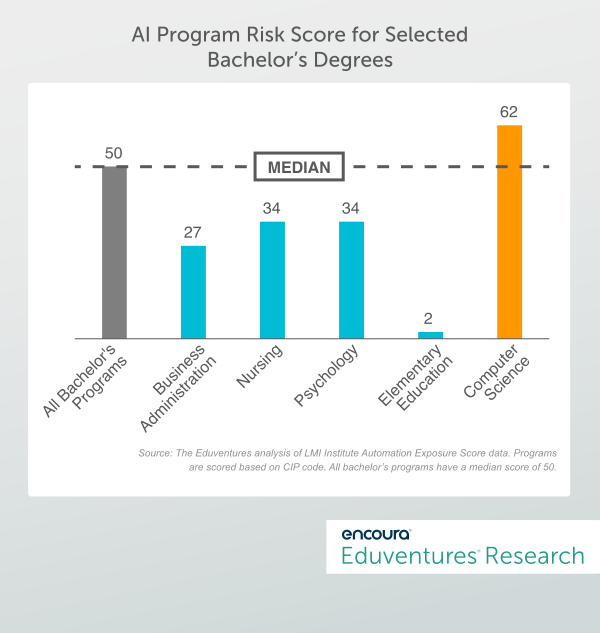
Figure 1.
Key observations of Figure 1:
- Business Administration (27), Nursing (34), and Psychology (34) are the largest bachelor’s programs by conferrals. While all fall below the median program risk score of 50, their aligned occupations still face some automation exposure.
- Elementary Education is the largest bachelor’s market with a very low risk score (2), driven by the high interpersonal communication demands that make these roles hard to automate.
- Computer Science is the largest high-risk bachelor’s market with a score of 62. Most programs in the broader Computer and Information Sciences category score above average due to their largely computer-oriented work, though demand for AI-related skills remains strong.
Notably, while the AI score provides valuable input, it cannot capture the rapid evolution of this technology. Robust program evaluation must also consider supply and demand dynamics, labor market trends, and prospective student preferences.
AI Opportunity
AI is still in the early days, and higher education has an opportunity to be proactive about program evaluation and aligned skills and outcomes. Institutions should incorporate durable skills that are resistant to automation, such as leadership, communication, creativity, and critical thinking. Institutions can use this disruption to revamp curriculum and align with workforce needs to produce graduates who can thrive into the 2030s and beyond.

After an exciting year of joining forces, the Encoura + RNL teams are reflecting on their top insights of 2025. Take a look below:
Top Takeaways From Our Analysts: Traditional Student Demand
Three Eduventures analysts reflect on the past year and share the one top insight that truly stood out to each of them.
Top Takeaways From Our Analysts: Non-Degree Demand & Program Innovation
The top lessons learned by our Eduventures analysts in the non-degree market and in program innovation.
What We Learned This Year: Eight Reports, Thousands of Voices, and One Clear Message About Students
Dr. Raquel Bermejo reflects on the eight RNL reports released this year.
