


Over the past several years, job descriptions for vice presidents of enrollment management have been revised. Skills like “strategic leadership” now appear in about a quarter of these job postings — nearly triple the share in 2021 — and “data analysis” has more than doubled. Institutions are now hiring enrollment leaders who can think cross-functionally across the enterprise. But changing the job description is the easy part.
Many institutions still approach enrollment through structures designed for an earlier era: Recruitment may be sophisticated but disconnected from retention and academic programs. Data may be plentiful but not collectively analyzed or intuitively translated into decisions. Enrollment leaders may execute institutional strategy without helping shape it.
How can we close the gap between the enrollment vision an institution aspires to and the structure it requires?
Assessing Enrollment Maturity
What does a mature enrollment organization look like? The Eduventures Enrollment Management Maturity Model examines the strength and scope of enrollment across the institution on four dimensions: “Strategic Enrollment Management,” “Student Lifecycle Integration,” “Technology & Data Access,” and “Team Engagement & Collaboration.” Each dimension progresses through four stages of maturity: “Initial,” “Operational,” “Strategic,” and “Integrated” (See Figure 1).
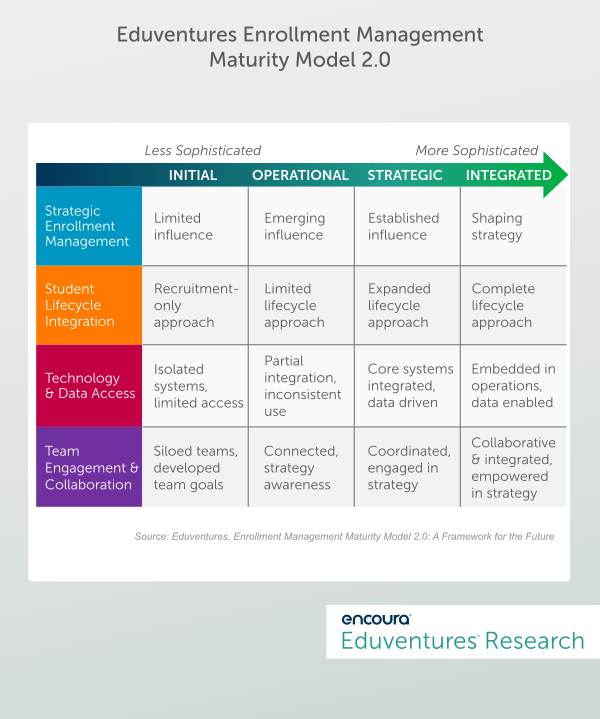
Figure 1.
The model provides institutions with a way to ask a deceptively simple question: Where are we today?
From Executing Strategy to Shaping It
The first dimension, Strategic Enrollment Management, concerns the role enrollment management plays in institutional strategy.
Academic portfolios, pricing, modality, student support, technology investments, and financial sustainability all have enrollment implications. Institutions operating at greater maturity recognize enrollment management not simply as a function responsible for producing a class of new students, but as a source of market intelligence and strategic leadership.
A useful test is: Is enrollment shaping institutional strategy or simply reporting to it?
From Recruitment to the Entire Student Lifecycle
Enrollment management maturity also depends on how institutions define the enrollment lifecycle.
At one end of the Student Lifecycle Integration dimension is a recruitment-only approach. At the other is complete lifecycle integration encompassing awareness, recruitment, influencers, matriculation, persistence, retention, graduation, career, and student outcomes. Mature enrollment organizations see the whole student lifecycle as connected to and part of their work.
Recruiting a student and supporting that student’s success requires institutions to consider another question: Are you stewarding students throughout their journey or handing them off?
Never Miss Your Wake-Up Call
Make informed decisions with the latest higher ed insights from Eduventures Research.
From Having Data to Using It
Today’s challenge with data is ensuring it’s actionable and understood. The Maturity Model’s Technology & Data Access dimension progresses from isolated systems and limited data access to partial integration, integrated core systems, and ultimately data embedded in institutional operations.
Mature enrollment organizations develop the ability to translate information into action with data and systems that help institutions determine where to focus resources, assess potential impact, establish realistic goals, and decide when a strategy should be expanded, modified, or discontinued.
A carefully designed strategic enrollment planning project supports collective data analysis, reviews qualitative norms and correlates with quantitative insights to advance technology and data access enrollment maturity.
In other words: Do your stories align with the data?
From Silos to Shared Enrollment Accountability
Team Engagement & Collaboration looks at how people and teams are working together, both within enrollment and across campus. In less mature organizations, enrollment teams may have strong goals of their own but little connection to the larger enrollment strategy. Greater maturity brings increasing awareness of institutional strategy, coordinated participation in that vision, and ultimately collaborative teams empowered to help shape it.
This leads institutions to ask: Are you building a team or a force multiplier?
Strategic enrollment planning can help operationalize this shift. Mature organizations create shared ownership, use data intentionally, prioritize actionable strategies, and establish accountability. This is where enrollment maturity becomes more than an organizational assessment and shapes how institutions plan.
Enrollment Maturity and Strategic Enrollment Planning Is Never Finished
Even reaching the Integrated stage across all dimensions of the Enrollment Maturity Model does not mean the work is done.
Figure 2 shows the dynamic and continuous cycle of enrollment planning.
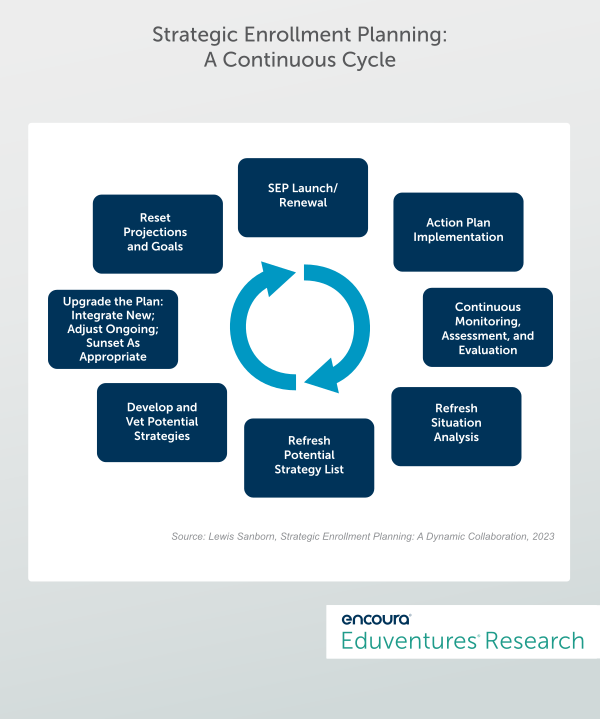
Figure 2.
This continuous reassessment may be one of the clearest markers of maturity — when strategic enrollment planning becomes part of institutional culture, governance, and decision-making.
The Bottom Line
Enrollment management is no longer simply a role, department, or annual plan. It is an institutional capability.
The most mature institutions connect enrollment strategy to the entire student lifecycle, give enrollment leaders meaningful strategic influence, embed data in decision-making, and establish shared accountability across campus. Just as importantly, they recognize that maturity is dynamic. Strategies must be continually assessed and adapted as markets and institutional realities change.
Institutions should therefore ask not only, “What is our enrollment strategy?” but also, “Are we organized to deliver it?”
The future of enrollment management will require more than better tactics. It will require institutions capable of aligning strategy, culture, investment, and planning around enrollment as an enterprise-wide responsibility.
