

Did you know that students interested in healthcare-adjacent majors are nearly 20% more likely to open institutional recruitment emails than those who want to study computer science or math? Email campaigns sent by Encoura’s Enrollment Marketing Services team, over the course of one year, confirm higher open rates among healthcare prospects.
Many institutions tailor their outreach messages based on the academic interests of their inquirers — personalizing outreach and making it more relevant to students. It can be an effective way to catch your prospects’ attention, but only if the intended recipients see the message.
Does your institution consider the channel — not just the message — when appealing to your prospects’ academic interest?
Tell Me Who You Want to Be, and I’ll Tell You How You Search
Why do we see different open rates for emails depending on academic interest? Perhaps certain subject lines were more appealing to students with specific interests and goals. But this would not explain consistently higher open rates among some student segments over the course of a year, across a broad range of sending institutions, and with multiple different messages.
Instead, there seem to be different levels of interest or trust in institutional emails. It might not be intuitive to connect this to what students want to study, but the Eduventures Student Sentiment Research™ strongly suggests that academic interest and college search behavior are related.
For instance, Figure 1 shows the most trusted information source about college for each of the “Big Five” academic areas — those with the largest undergraduate market share and strong growth according to the Eduventures 2025 Admitted Student Research™.
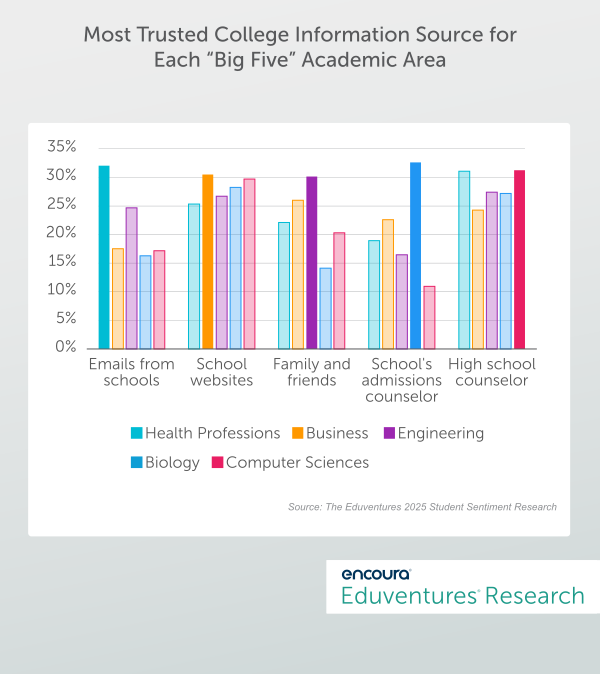
Figure 1.
Figure 1 not only shows which information source is most trusted by students interested in the “Big Five” (health, business, engineering, biology, and computer science), but it also shows where these information sources fall among other majors. For example, students interested in health majors trust emails the most. This explains the relatively higher open rates.
But we can also see that health major prospects nearly equally trust their high school counselors — a trust shared by computer science prospects, who place their highest trust in high school counselors. This is just one of many data points that shows the different approaches to college search based on academic interest. Understanding these nuances can help institutions get their messages heard.
As a starting point, here are the search profiles for students interested in the “Big Five.”
The “Big Five” Majors
Health Professions: Rather than rankings, these prospects rely on high school counselors for college recommendations. They actively engage with admissions through email and print mail and turn to social platforms — especially Pinterest and Facebook — to research scholarships and campus life. These students have yet to embrace AI-powered tools like generative AI, scholarship search engines, or admissions calculators.
- Why? Often the first in their families to attend college, these students cover the basics of search, aided by counselors.
- Engagement strategy: Strengthen relationships with high school counselors and launch coordinated email and direct mail campaigns highlighting scholarship opportunities and student success stories.
Business: Business prospects rely on trusted networks — family and friends — to discover colleges, making word-of-mouth a critical entry point. While they use Facebook more than other students, their social media engagement is more transactional; they're less likely to explore campus community content. Instead, these students take a more direct approach: they visit campus to evaluate fit for themselves.
- Why? These students can rely on their educated, higher-earning parents to guide them through the search and take them on campus visits.
- Engagement strategy: Focus on family engagement and create family-friendly visit options that showcase a mix of campus life and professional outcomes.
Engineering: Engineering prospects turn to institutional websites primarily for choice evaluation rather than broad exploration. They consume video content at higher rates than other students — preferring in-depth YouTube content over TikTok's quick takes — and frequently watch videos directly on college websites. Their analytical approach extends to AI adoption: engineering students lead all groups in ChatGPT usage for college search.
- Why? These mostly male students look for efficiency in search but also use their analytical skills for careful evaluation.
- Engagement strategy: Invest in high-quality video content featuring faculty research, lab tours, and technical deep dives into your programs. Develop AI-friendly content with clear, structured information that ChatGPT can accurately surface when students query about your engineering offerings.
Biology: Biology prospects conduct the most comprehensive college searches, actively gathering information across multiple channels while focusing on institutional and student-created content. They place high trust in admissions counselors, current students, and their high school counselors; consume videos across social platforms and websites; and lead in adopting AI-powered tools like admissions calculators and scholarship search engines.
- Why? These more often female students are academic achievers who apply their work ethic to college search and see counselors and peers as search allies.
- Engagement strategy: Meet these omnichannel researchers everywhere with consistent, authentic content: empower admissions counselors and current students as primary storytellers and create relevant video content across program websites and social platforms.
Computer Science: Computer science prospects show notably lower engagement across college search activities, approaching the process with greater skepticism. They're least likely to consume student-created content and express lower trust in both current students and admissions counselors. Their social media usage is minimal except for targeted visits to YouTube and Reddit, where they focus on scholarship and financial aid information.
- Why? Most often male students, and often from lower-income households, these students may be more skeptical about the value of college.
- Engagement strategy: These minimally engaged students need efficient, credible information rather than extensive promotional messaging. Monitor third-party information sources and showcase placement rates, starting salaries, curriculum details, and research opportunities.
The Bottom Line
Tailoring messages by academic interest is a smart first step. But as this analysis shows, it is not enough. Students in the “Big Five” majors do not just respond to different content — they rely on different information sources, trust different voices, and engage through different channels.
Health prospects are more responsive to email. Engineering prospects turn to structured website content and long-form video. Biology students research broadly across platforms. Computer science prospects are more skeptical and seek efficient, outcomes-focused information. Business students lean on family and in-person experiences.
Institutional email campaigns remain effective at scale. But optimizing outreach requires looking beyond message personalization to channel alignment. Meeting students where they are, both in content and channel, is key to cutting through the growing noise of recruiting a shrinking generation.

