

While first-year students remain the mainstay of four-year college enrollment, transfer students are an increasingly strategic component of the mix. According to the National Student Clearinghouse (NSC), transfers account for 13% of all undergraduates, with two-year to four-year transfers driving recent growth.
As community college enrollment rebounds, vertical transfer momentum is returning as well. Yet institutions’ transfer strategies often remain anchored to traditional assumptions — associate completion, late-stage recruitment, and linear pathways.
Student behavior tells a different story: many vertical transfer students plan early and prioritize affordability, while a growing population transfer before earning a credential. As transfer volume regains momentum, institutions have an opportunity to reassess whether their outreach timing, partnerships, and infrastructure align with how these students are making their transfer plans.
The Leading Transfer Pathway
“Transfer student” can mean many things — there are four-year to four-year pathways (lateral transfer), two-year to four-year pathways (vertical transfer), reverse transfers, returners, and wide variations in modality, course load, and credential type. Despite this complexity, vertical transfer often remains the default understanding of transfer — and with good reason. According to NSC’s fall 2024 data, 42% of transfer enrollment stems from a vertical transfer pathway.
While vertical transfer enrollment declined following the pandemic, NSC also reports year-over-year growth (from 2023 to 2024), mirroring enrollment gains at public two-year colleges beginning in fall 2022. Because three-fourths of vertical transfer students enroll at public four-year institutions, renewed growth places added strategic weight on how those institutions engage this population.
Vertical Transfer Students Are Planning Now
The Eduventures 2025 Admitted Student Research™ shows that 64% of vertical transfer students began thinking about their four-year options either before starting at their two-year college or within their first year. This means that four-year colleges that wait to engage students until they are nearing associate degree completion risk entering the conversation too late.
This timing has structural implications. Many four-year institutions concentrate outreach, articulation conversations, and recruitment resources around students nearing degree completion. But if planning is already underway, engagement may be reactive rather than influential.
Recent NSC data also shows growth in vertical transfer students enrolling at four-year colleges without a credential, signaling a shift away from the traditional associate-to-bachelor pathway that still anchors many transfer strategies. The associate-to-bachelor pathway remains important; however, transfer student behavior is less linear than strategy often assumes. Again, institutions structured around completion checkpoints may be missing students who are ready to move earlier.
Practicality Drives Decision-Making
Affordability and value are not just starting points for students who begin at two-year colleges — they remain central throughout the transfer decision. More than a quarter of students cite cost as the most important reason for choosing a two-year pathway, and 62% of vertical transfers in the Eduventures Admitted Student Research identify affordability as a top decision factor when choosing a four-year college.
The Eduventures Transfer Student Research™ further highlights concerns about debt accumulation, limited financial aid, and challenges in the transfer process for vertical transfer students. Given their practicality, it’s unsurprising that 93% of first-time students choosing a two-year pathway stay in-state.
Together, these findings point toward local, cost-transparent transfer strategies. Clear academic pathways, transparent outcomes, predictable credit transfer, and upfront financial planning are not value-adds — they are central to how transfer students evaluate their four-year options.
Forming Transfer Allies Across the Pipeline
Prospective vertical transfer students begin their four-year search through a mix of personal networks and digital tools. Figure 1 highlights the most cited starting points. Personal relationships and college advisors lead nearly in tandem, with online search engines close behind.
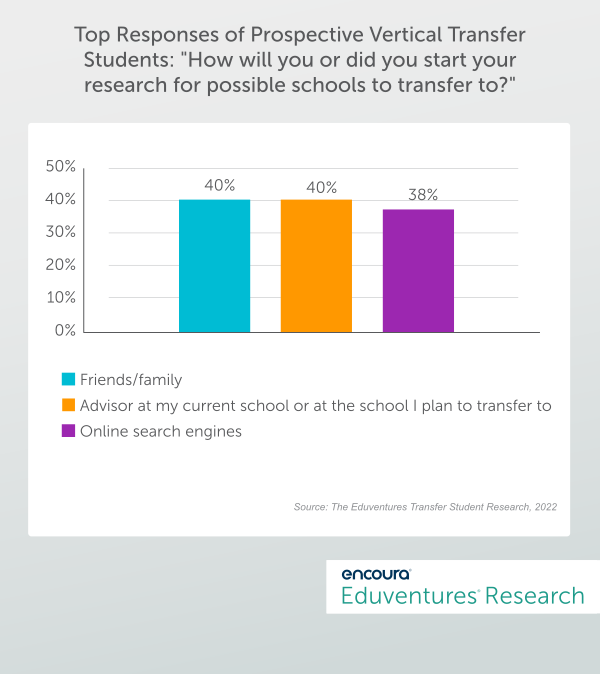
Figure 1.
For four-year institutions, this presents both opportunity and constraint. Advisors are critical connectors, yet their capacity is constrained by substantial caseloads. Simply relying on individual relationships is unlikely to scale.
This underscores that strong vertical transfer strategies extend beyond individual relationships alone. They require infrastructure — clear articulation agreements, shared advising tools, coordinated financial guidance, and dedicated transfer roles — to reduce friction across the student lifecycle.
And, while many transfer partnerships focus on two-year colleges, consideration should also be given to how four-year colleges can use secondary education networks to form transfer partnerships with students at the start. Partnerships that create smooth pathways at the point of two-year college enrollment and recognize the distinct needs and interests of transfer students, along with the roles needed for their continued support, are ideal.
The Bottom Line
Nearly two-thirds of vertical transfer students report difficulty in transferring — a concerning figure for the largest transfer student subset, signaling the need for colleges to reflect on their transfer strategies even before students enroll at a two-year institution.
Relationships matter; infrastructure sustains. Institutions that rely solely on advisor connections or articulation agreements without investing in dedicated transfer roles, coordinated financial guidance, and transparent pathways risk falling short. Transfer students plan early, weigh cost heavily, and navigate complex advising systems. Their needs differ in timing and intensity from first-year students, and strategy must reflect that difference.
Why wait? Many students begin exploring four-year options at or before their first year in a two-year college. Institutions that engage earlier — through high school networks, two-year partnerships, and clear pathway designs — position themselves before decisions solidify. Transfer momentum is returning. The question is whether institutional strategy keeps pace.

