

Higher education has launched no shortage of new academic programs. From 2014 to 2023, institutions introduced more than 10,000 new bachelor’s programs nationwide. Five years after launch, however, only about half are growing.
With demographic pressures mounting, institutions have less room for programs that fail to gain traction. But decisions about what to launch can still rest on familiar assumptions: a competitor offers it (aka “Keeping up with the Joneses”), someone on campus is pushing for it (aka “The Crusade”), or the field seems to be getting a lot of attention (aka “The Shiny Object”). Sometimes the case amounts to little more than: “If We Build it, They Will Come.”
So, what actually separates new programs that grow from those that don’t?
Beyond Market Demand
Program development often starts with demand: Are students interested? Is the field growing? Are employers hiring?
Those questions matter, but they aren’t enough. IPEDS conferral data was used to estimate a regression model of conferral growth for new programs. This model showed that two other factors can significantly alter a program’s prospects: 1) the competitive structure of the market, and 2) how well the proposed program fits the institution’s existing academic portfolio.
First, what do we mean by “competitive structure?”
Eduventures examined market concentration — whether completions were distributed among many institutions or dominated by a few — and found a clear relationship with new program growth (Figure 1).
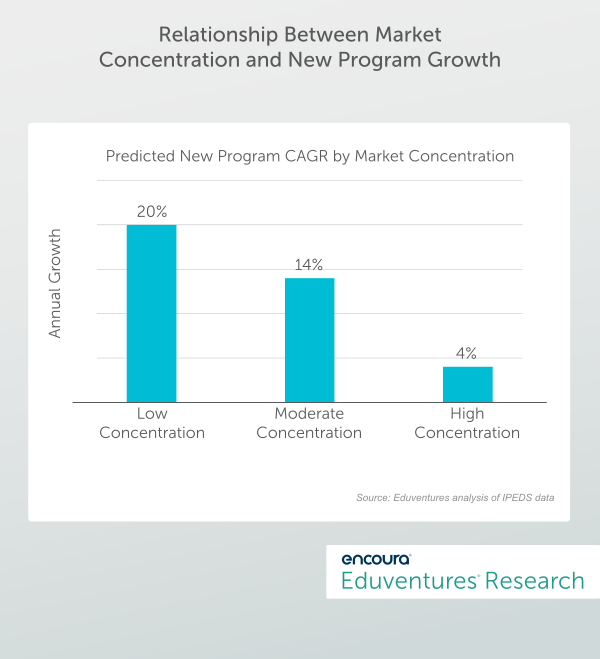
Figure 1.
New programs entering markets with low concentration averaged 20% annual growth. As concentration increased, growth deteriorated substantially. Moderate-concentration markets were associated with 30% lower growth (14%), while programs in high-concentration markets grew 71% more slowly (4%).
That might suggest a simple rule: steer clear of markets dominated by an established competitor.
But market size complicates that conclusion.
Market Size Changes the Equation
The model found that, in large markets, new programs in competitive fields grew at about 30% annually, compared with roughly no growth for programs entering markets dominated by an existing provider.
In small markets, however, that difference essentially disappeared. New programs in both competitive and highly concentrated markets grew at around 15% annually.
Scale and brand may help explain the difference. Institutions that dominate large conferral markets may have established brands and market positions that are difficult for newcomers to overcome. In smaller markets, a new entrant may have more opportunity to establish its own position.
The takeaway: Concentration alone is not a go/no-go signal. Entering a large market with a dominant incumbent is risky. Concentration in a smaller market may still leave room for a well-positioned challenger.
But what makes an institution well positioned?
Are You the Right Institution To Offer It?
Since market opportunity is only one side of the equation, Eduventures developed a measure of portfolio fit based on how frequently programs are offered together at the same institution. Programs commonly found on the same campus may share faculty expertise, infrastructure, students, or other resources.
Our analysis (Figure 2) suggests that fit has a substantial relationship with compound annual growth rate (CAGR).
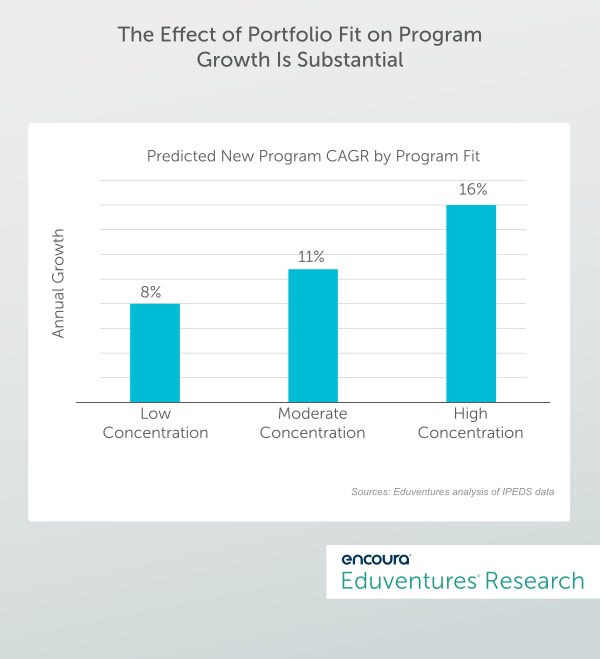
Figure 2.
Programs with poor portfolio fit averaged 8% annual growth. Moderate-fit programs grew 37.5% faster than these (11%), while programs with the greatest fit grew 45.5% faster than poor fits (16%).
In fact, portfolio fit is one of the strongest predictors in the Eduventures model — stronger than most market-level variables.
Programs adjacent to existing institutional strengths may benefit from shared faculty expertise, overlapping student pipelines, infrastructure, and established credibility in related fields.
This does not mean institutions should never diversify. It means diversification carries a measurable growth penalty that should be considered before a program launch.
Don’t just ask, “Is there demand for this program?” Make sure to also ask, “Are we the right institution to offer it?”
And Then There's AI
Today’s portfolio decisions also need to account for how the labor market may change.
Our analysis found that in their IPEDS descriptions, higher AI-risk programs were more frequently associated with terms such as technical, specific, skill, procedure, and technologies. Lower-risk programs were more closely associated with care, health, regulations, evaluate, organize, and plan.
The patterns point to three characteristics of work that may be more difficult for machines to replace: authentic human connection and care, aligning plans with organizational goals, and accountability.
The lesson is not to avoid technical programs. Rather, institutions should consider whether new programs combine technical expertise with human judgment and capabilities that may become more valuable as AI takes on procedural tasks.
The Bottom Line
No single measure can tell an institution whether a program is worth launching. Strong program decisions require looking at the opportunity from several angles:
- Market concentration and size. A dominant competitor presents greater risk in a large market than it may in a smaller one.
- Portfolio fit. Programs aligned with existing institutional strengths have a measurable growth advantage.
- AI robustness. Consider how changing technology could reshape the work graduates are preparing to do.
Data cannot eliminate the risk of launching a new academic program. But it can help institutions distinguish between an attractive market and an opportunity they are actually positioned to capture.

