

The Carnegie Classification has sorted America's nearly 4,000 colleges and universities for over 50 years. In 2025, the classification was significantly redesigned. The familiar categories tied to research activity, degree offerings, and institutional type were overhauled, and a separate Access and Earnings Classification was introduced for the first time.
The redesign takes direct aim at Carnegie’s longstanding role as shorthand for prestige and institutional reputation, particularly the “R1” hierarchy that has shaped institutional strategy for decades. As colleges face growing pressure to demonstrate value and outcomes, these changes will impact how institutions define their missions, identify peers, and frame their value propositions.
Carnegie Classification Redux
The 2025 redesign replaces Carnegie’s familiar categories with a more multidimensional framework. The old M1, M2, and M3 classifications are gone, along with the longstanding emphasis on research activity and highest degree awarded.
The new institutional classification organizes institutions across three dimensions:
- Award Level Focus: Where an institution awards the majority of its degrees.
- Academic Program Mix: The fields in which half or more degrees are awarded: special focus (11 categories), professions focused, or mixed.
- Institution Size: Total 12-month student headcount, including full- and part-time, undergraduate and graduate.
But the institutional overhaul was only part of the story. Carnegie also introduced a separate Student Access and Earnings Classification focused entirely on who institutions serve and whether graduates see improved economic outcomes.
Student Access and Earnings Classification
The framework asks two questions of every institution: Who does it serve, and does it improve their economic outcomes?
The Access Measure compares enrollment of Pell-eligible and underrepresented students to the population in those locations; the Earnings Measure compares graduate earnings to local workers (ages 22-40) with only a high school diploma in those same geographies. Institutions that score above regional parity on both dimensions are designated Opportunity Colleges and Universities.
Figure 1 demonstrates how these two dimensions produce six combinations. Each school can be placed into a matrix based on either “lower” or “higher” access, and “lower,” “medium,” or “higher” earnings among graduates. Institutions landing in “Higher Access” and “Higher Earnings” are performing above regional parity and designated as “Opportunity Colleges and Universities.”
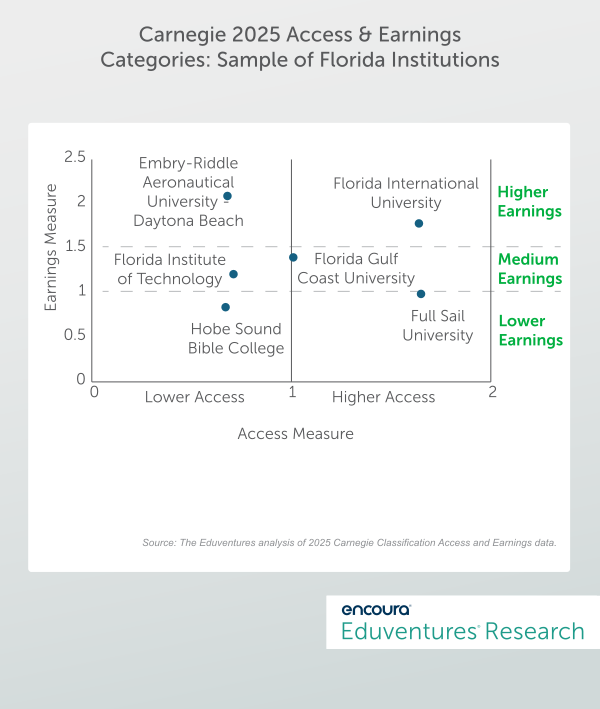
Figure 1.
To illustrate how the framework works in practice, consider six Florida baccalaureate institutions, each of which falls into a different sextant:
1. Florida International University (Higher Access/Higher Earnings): Above-parity access and strong graduate earnings, the definition of an Opportunity University.
2. Florida Gulf Coast University (Higher Access/Medium Earnings): Broad access with solid but not top-tier earnings outcomes.
3. Full Sail University (Higher Access/Lower Earnings): Strong access undermined by graduate earnings at or below the regional high school benchmark.
4. Embry-Riddle Aeronautical University–Daytona Beach (Lower Access/Higher Earnings): Exceptional earnings driven by a specialized engineering mission, but Pell and underrepresented enrollment fall short of regional benchmarks.
5. Florida Institute of Technology (Lower Access/Medium Earnings): Graduates outearn regional peers, but enrollment skews away from Pell and underrepresented populations.
6. Hobe Sound Bible College (Lower Access/Lower Earnings): A narrow, faith-based mission that falls below regional benchmarks on both dimensions.
The framework is descriptive, not prescriptive. It identifies where institutions stand relative to their regional context, giving leaders, researchers, and students a clearer picture of the role an institution plays in its community.
The Bottom Line
The old classification simplicity is gone. Now, we have a system that better reflects the actual diversity of American higher education and gives institutions something to aspire to: “Opportunity” status.
But knowing your new Carnegie classification is just the first step. The more important question is whether your institutional identity — as students perceive it — actually aligns with what the data says you deliver.
The Eduventures Brand Neighborhood™ framework offers exactly that lens. Where Carnegie's Access and Earnings Classification measures what you deliver, Brand Neighborhood capture how prospective students perceive you across dimensions like affordability, quality, and campus culture. An institution may produce strong outcomes while projecting the wrong market identity — or vice versa.
While these changes will unfold gradually, institutions will increasingly be judged through these lenses: award focus, program mix, size, access, and earnings.
This is the moment to pressure‑test your narrative against your data:
- Does your new Institutional and Access and Earnings Classification reflect both the institution you are, and the story you are telling?
- Who shares your Institutional Access and Earnings profile? Are those the same competitors and peers you have historically benchmarked against?
- If your institution is not an Opportunity College or University today, what would it take to get there? Is this the right goal?
The 2025 Carnegie redesign is best understood as a strategic mirror: a structured way to revisit mission, markets, and outcomes. For some institutions, the redesign may confirm their current identity. For others, it may reveal the need for a different strategic narrative.

