

Last week, I reviewed two of my three predictions for higher education in 2025:
- Prediction 1 (WRONG): The number of fully online undergraduates will surpass the “campus-only” cohort for the first time.
- Prediction 2 (RIGHT): U.S. Department of Education will become collateral damage in the first year of Trump’s presidency.
I now turn to my final 2025 prediction:
- Prediction #3 (PART-RIGHT): Grad PLUS loans will be eliminated, and schools will be on the hook for unpaid student debt.
What happened?
Grad PLUS was indeed eliminated. The One Big Beautiful Bill Act (OBBBA) amended the Higher Education Act, terminating the federal government’s ability to offer these loans. Congress sees an opportunity to reduce spending and shake up the market.
Champions of Grad PLUS elimination say that the scheme undermines market discipline, encourages schools to raise tuition, and funds some questionable programs. Critics worry that without public subsidy, high-potential but lower-income students will be forced out of the grad school pipeline.
Graduate students, from July 2026, may now borrow up to $20,500 a year in federal Stafford Unsubsidized loans, up to a maximum of $100,000. Professional students (defined for federal loan purposes — and to the chagrin of programs judged not “professional” — as students pursuing specific credentials in 11 fields, such as Medicine, Dentistry, and Pharmacy) may borrow up to $50,000 a year (maximum of $200,000).
The prior cap, for both graduate and professional students, was $138,500, which factored in any prior Stafford loans (including at the undergraduate level).
The $20,500 annual cap has been in place since 2011. This means that its value has eroded. If it had been adjusted for inflation, the value of the cap would be almost $30,000 today (Figure 1). Grad PLUS stood in the breach, providing additional borrowing up to the unmet total cost of attendance.
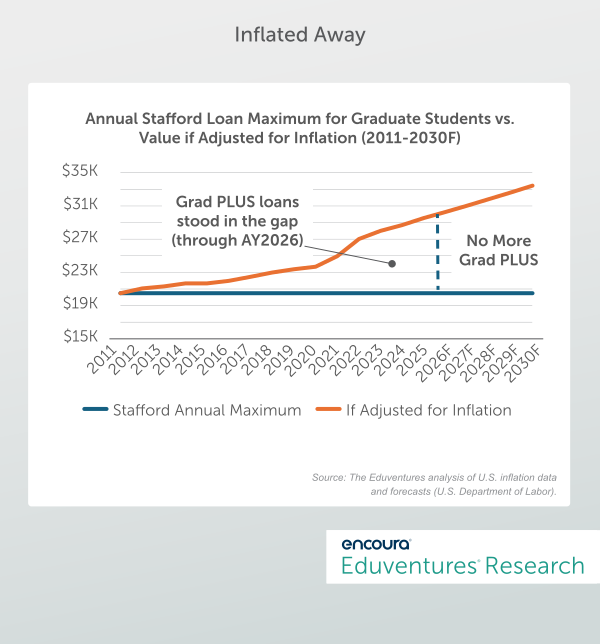
Figure 1.
For many schools and programs, the annual cap is not a problem. Average in-state tuition and fees for graduate programs at public institutions was about $12,000 in 2024. The average was $21,500 at privates. But because the cap has not grown with inflation, many more programs are above the cap today than back in 2011. Grad PLUS closed the gap. The fact that the Department chose not to raise the cap, even with the demise of Grad PLUS, signals that the priorities are market rationalization and cost reduction.
Many “professional” programs under the federal definition cost more than the new $50,000 annual cap. In 2024, the average Dentistry (DDS) program was $60,000 and Medicine (MD), $48,000.
As of June 2025, there were 1.8 million Grad PLUS borrowers with debt outstanding of $119 billion. Only 16% of current graduate and professional students (about 450,000 people) have a Grad PLUS loan but account for a third of total federal graduate and professional student borrowing. Current Grad PLUS students owe about $14 billion.
What happens now?
For schools (particularly the more expensive and less elite focused on programs that lead to lower-paying jobs), adaptation will not be easy, but solutions will emerge. After all, undergraduate federal loan limits are much lower than the new graduate/professional caps. Pell Grants and Parent PLUS loans make up some of the gap, but a combination of family cash, institutional and state aid, private lenders, and institutional sorting do the heavy lifting.
A personal anecdote points the way: My niece (daughter of a nurse and a social worker) just started nursing school at an elite private university. She already took out a private loan with a better rate than Grad PLUS.
My niece’s experience suggests that talented students will still get into top programs, and that funding alternatives are waiting in the wings. But is she representative?
New Lenders vs. New Models
Grad PLUS (in place since 2006) has curbed the private loan market. It may seem like a good bet to lend to an aspiring doctor or lawyer (or someone like my niece who wants to be a Nurse Practitioner), but lenders are wary of applicants with limited credit histories, modest present income, and professional futures that are not guaranteed. A first-generation college student who is admitted to medical school and plans to work as a general practitioner in a rural area back home may struggle to repay a big loan.
Such a scenario may be exceptional in medicine or law (which will generally prove enticing to mainstream lenders). Expensive programs in less lucrative fields, such as social work and counseling, however, may be passed over.
Grad PLUS, charging above-market interest, was supposed to generate a positive return for the taxpayer but mixed student outcomes and loan forgiveness dragged the program into the red. This is not reassuring for private lenders who will insist on comprehensive completion and earnings data from schools to inform underwriting.
Other private market possibilities include:
- Good-Fit Lenders. Pension funds and other large-scale, risk averse entities willing to trade returns for predictability might find grad loans at scale attractive.
- Institutional Lending. Large universities might help finance some graduate/professional students or sign up to absorb a portion of losses to incent a conventional lender to buy-in.
- Employer Lending. Large employers that hire graduates in certain occupations could plug the funding gap for some students, linking repayment to employment.
- Philanthropy. Foundations will step forward to support some needy students.
It will take time for private options to coalesce. In the meantime, expect to see the following institutional sorting:
- Downsizing. Smaller class sizes at less prestigious, higher-price graduate and professional programs associated with lower-paid occupations.
- Retrenchment. Caps or pauses at doctoral programs accustomed to a funding mix of institutional support and Grad PLUS.
- Cost Reduction. Further resort to shorter programs and online and self-paced program components to drive down cost and tuition.
- Economies of Scale. Use of scholarships to boost enrollment to offset smaller margins.
- Degree Alternatives. Schools will use cheaper certificate programs to tempt students toward degree enrollment.
The Bottom Line
In summary, more lucrative graduate/professional programs will assemble new coalitions of lenders, while programs with more modest returns will re-think credentials, cut costs, and lower prices. Some programs will prove non-viable, but most will make the transition. Less expensive graduate programs in social work and counseling may replenish parched pipelines.
Regardless, the demise of Grad PLUS puts more pressure on the graduate market, already facing flattening domestic cohorts, reduced international student demand, and big cuts to federal research funding.
The second part of my prediction did not pan out. The OBBBA did not include any requirement for schools to repay delinquent student loans, as had been proposed by the (not-enacted) College Cost Reduction Act. The idea may re-emerge, whether from a congressional committee or a Truth Social post. For now, institutions face new program-level accountability metrics and disclosures (simplified versions of Gainful Employment and Financial Value Transparency) that risk federal loan eligibility but not loan repayment.
Look out for my 2026 predictions later in January.

Dive into the top 5 digital marketing trends that will lead higher education in 2026.
