

What happens when there isn’t a college in your backyard? Rural students approach college with distinct experiences and perspectives, though most have the shared experience of distance from higher education institutions. Rural students have some of the strongest graduation rates in the country at 90% (NCES), yet, according to National Student Clearinghouse, 53% enroll in college immediately after graduating compared to 59% of their urban peers.
For institutions focused on expanding college access, rural students and their communities are part of the picture. What does Eduventures research tell us about these students, and how does that shape recruitment strategy?
Rural and small-town students make up about 19% of public high school seniors (NCES), while postsecondary institutions in rural areas account for just 10% of the nation’s colleges and universities (IPEDS). Rural America spans border towns, agricultural communities, sovereign lands, tourism hubs, and more, making the rural student experience anything but uniform.
In the Eduventures Admitted Student Research™, four themes emerge about how rural students make choices about college:
1. Rural Students Bring a Distinct Student Profile
Rural and small-town students enrolling in college are more likely than their urban peers to be first-generation students and come from lower-income households. They are also more likely to report an A+ grade average.
Table 1 compares key demographic characteristics of rural and small-town students enrolling in college and how they compare to students from urban areas.
Enrolling Student Demographics by Urbanicity*
| Metropolitan | Rural + Small Town | |
|---|---|---|
First-generation college student | 29% | 41% |
Estimated household income >$150K | 22% | 13% |
Race/ethnicity is white | 48% | 72% |
A+ grade average (enrolling students only) | 21% | 29% |
Enrolling in college immediately after high school** | 59% | 53% |
Table 1.
*Urbanicity follows USDA’s Rural-Urban Commuting Areas with metropolitan areas defined as primary commuting flow to or within a metro area of 50,000+ population, and Rural + Small Town as primary commuting flow to a small town (less than 10,000 population), or entirely outside any urban area.
Source: The Eduventures Admitted Student Research 2023-2025; **National Student Clearinghouse High School Benchmarks, Class of 2024 High School Graduates
Together, these findings complicate common assumptions about college access. Compared to urban students, rural students enrolling in college demonstrate strong academic achievement, while also typically navigating tighter finances and more often being the first in their family to attend college. Institutions seeking to serve rural communities should consider these students as part of their broader access strategy — not simply as another geographic recruitment market.
What should enrollment teams do? Recognize the different dimensions of access rural students may be navigating.
- Many rural students are navigating college as the first in their family. Ensure they feel a sense of belonging, minimize use of higher ed jargon, and provide communication that is transparent and digestible. Remember their families are part of that calculus too.
- Cost is a real barrier. For students who come from lower-income households, it’s important to take the guesswork out of price, expand financial aid access, and build financial literacy into the funnel to make college feel attainable.
- Don't mistake achievement for access. Strong grades do not eliminate financial, geographic, or informational barriers. Rural students may bring considerable academic strength while still needing greater support navigating the path to college.
2. Academic Interests Are Shifting
Rural students are more likely than their urban peers to be interested in studying Engineering, Health Professions, Education, and Agriculture — fields with visible connections to many rural communities.
This academic mix has shifted since the pandemic. Health Professions, previously the clear leader among rural students at nearly 21% interest, has fallen 7 percentage points and lost its number-one ranked position among student interest.
Today, Engineering is the leading interest, at 15%. While interest in Engineering grew among urban students following the pandemic (by 7 percentage points), rural student growth outpaced it slightly (with growth of 9 percentage points).
This shift aligns with another trend among rural and small-town students: the growing importance of hands-on, real-world learning. Since the pandemic, hands-on engagement has become a more important enrollment driver for rural and small-town students, while its importance among urban students has remained relatively unchanged.
What should enrollment teams do? Connect academic programs to tangible experiences and outcomes.
- Lead with applied programs. Hands-on fields resonate with rural students’ interests and motivations. Less visible academic areas will need earlier engagement and exposure to compete.
- Show, don’t tell. Highlight internships and the opportunities outside the classroom to show rural students how their college experiences translate to their goals while also reinforcing the value of your institution.
3. Rural Students Decide Earlier
Eduventures has tracked a shrinking college decision window across all first-time students, with a larger proportion citing they knew where they would enroll by the fall or sooner of their senior year. For rural students, that shift is even more pronounced.
The Eduventures Admitted Student Research consistently finds that rural students know where they will enroll sooner than their metropolitan peers — and early decision-making has increased since the pandemic.
Figure 1 shows how the decision window has shifted following the pandemic.
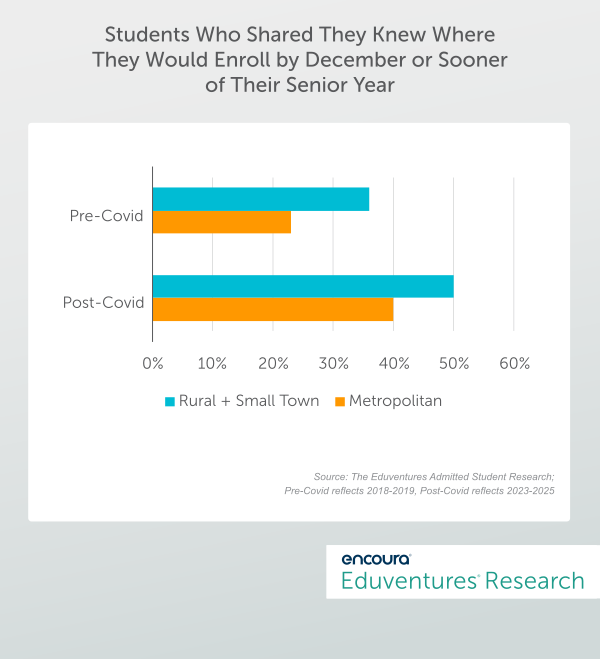
Figure 1.
Following the pandemic, half of rural students said they knew where they wanted to enroll by December, compared to 40% of urban students. Their consideration sets are also narrower: half of rural students applied to four or fewer institutions, compared to 42% of metropolitan students. This indicates that getting on their radar requires early engagement.
What should enrollment teams do? Get into the consideration set before it closes.
- Start sooner. Waiting until senior year means missing out. Earlier engagement gives rural students more time to learn about your institution and the college process before they narrow their choices.
- Think beyond the individual student. Earlier outreach can also build familiarity among families, counselors, schools, and communities — particularly important for students who may have less direct exposure to higher education.
4. For Rural Students, ROI Is the Reality
Affordability persists as a key enrollment driver, regardless of urbanicity. But for rural students, it is the single most-cited response to the question, “What mattered most in your college decision?”
Where students ultimately enroll reinforces the importance of examining cost alongside geography: 70% of rural and small-town students enrolled in-state, compared to 64% of students from urban areas. Despite this in-state enrollment gap, rural and small-town students were no more likely to cite proximity to home as their top reason for choosing a college (6% rural vs. 7% urban).
The data cannot tell us why an individual student stayed in-state, but the combination of high in-state enrollment and the importance rural students place on affordability suggests institutions should not assume staying closer to home is simply about wanting to remain nearby.
What should enrollment teams do? Make both price and value visible early.
- Take the guesswork out of cost. Make sure sticker price doesn’t prevent students from exploring their options. Make financial aid and net-price information accessible, understandable, and easy to find.
- Make the value case concrete. Affordability answers, “Can I attend?” Value answers, “Is it worth it?” Outcomes, career connections, experiential opportunities, and other tangible benefits help students understand what they will receive for their investment.
The Bottom Line
Rural students are more than a geographic segment. Eduventures research points to differences in: who they are, what they want to study, when they decide, and how they weigh cost and value.
Geographic distance isn’t the only distance institutions close when supporting rural students. Earlier engagement can build familiarity with your institution and strengthen relationships in students’ communities. Clearer cost information can make affordability tangible. Greater exposure to academic and experiential opportunities can help students envision where college can take them.
