

About 75% of admitted students say that scholarships or grants influenced their college decision. Between award letters, websites, emails, calculators, counselors, and social media, students and families have access to more financial aid information than ever before.
The challenge, according to Eduventures data, is not a shortage of information, but of interpretation. Understanding affordability requires more than receiving a financial aid offer. Students must make sense of financial aid, college costs, and value while navigating one of the first major financial decisions of their lives.
The Eduventures 2025 Admitted Student Research™ explores how students engage with cost and financial aid resources, revealing where institutions are most successful at turning information into understanding.
Affordability consistently ranks among the most important factors shaping college choice. Yet it can also be a roadblock for students acclimating to higher ed’s jargon and systems, while balancing a complex and highly personal financial decision. For institutions, the enrollment stakes are particularly high among in-state and low-income students, where understanding cost and aid can significantly influence enrollment outcomes.
Where should institutions begin? Figure 1 examines the resources students use to understand the cost and financial aid offers of their enrolling institution and identifies which resources students rate as “very good” or “excellent.”
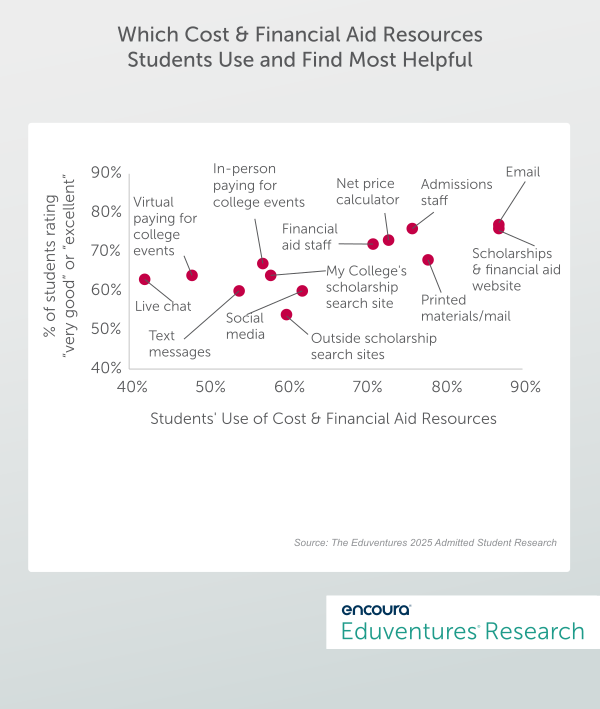
Figure 1.
Where Students Find Clarity
Encouragingly, more than half of students who used cost and financial aid-related resources found them helpful. Yet, some resources proved more effective than others, revealing opportunities for enrollment teams to refine their approach. Low-income students, in particular, use these resources more frequently than their higher-income peers — a reminder that these tools are most effective when personalized.
Figure 1 shows that even in a world with countless ways to reach students, you don’t need to overcomplicate it. Tried-and-true channels — email and institutional websites — emerge as leaders in both use and usefulness. While inboxes are crowded, students tune in when communications demonstrate relevance to their situation. Paying for college is personal, and outreach should reflect that.
Scholarship and financial aid websites are more than repositories of information — they should be viewed as decision-making tools. Pages designed primarily for current students can create confusion for prospective students and families. Tools like net price calculators help students see a more personalized picture of cost, while webpages built with incoming students in mind can make complex information easier to understand. This becomes even more important as students increasingly turn to AI tools that rely on institutional websites.
Figure 1 also reveals the power of people. Admissions and financial aid staff rank among the most valued resources for students, underscoring the importance of cross-training and emphasizing how admissions and financial aid teams are key to the incoming student decision-making. For students, cost and enrollment are one conversation. Institutions that reflect that in their support of students create a smoother experience.
This also highlights the importance of personal connections extending beyond campus. When asked who was most helpful in understanding cost and financial aid, students first identified parents/guardians (49%), then financial aid counselors (26%), high school counselors (22%), and admissions counselors (21%). Students are making smart use of trusted relationships when it comes to navigating college costs and financial aid. Given their influence, supporting parents’/guardians’ understanding of cost and value in a personal way is a powerful tool in supporting students through the decision-making process.
Complementary Channels of Support
This data highlights that other channels play a supporting role in helping students understand cost and financial aid. Short-form content vehicles like social media, live chat, and text messages rank lower in both use and usefulness. These channels are effective for reminders and action-oriented communications but are less suited to helping students interpret complex questions about affordability.
Scholarship search engines also rank lower than expected. This is notable because scholarship support is the most requested resource among admitted students. While students clearly want help finding scholarships, the search and application processes may pose friction rather than clarity.
Events similarly play a complementary role. Cost and financial aid are deeply personal topics, while events are designed to serve many students at once. Creating opportunities for individualized conversations with admissions and financial aid staff can help students move from information to understanding.
The Bottom Line
Information on college cost and affordability is more available than ever. The challenge is making sure that information is reaching students in ways that are clear, accessible, and designed with prospective students in mind:
- Campus professionals, high school counselors, and parents continue to play an outsized role in helping students make sense of cost and aid. Their guidance provides the personalized and trusted support students value most.
- Digital channels like email and the financial aid website remain foundational. Applying an incoming student lens to these information-dense channels and leveraging tools like net price calculators can help students develop a clearer picture of cost.
- Channels that are less able to deliver personalized support play a more limited role. While helpful for deadlines or action-oriented reminders, they are less effective in helping students disentangle costs and affordability.
Providing access to information on affordability, cost, and value is important, but so is supporting interpretation. Creating clarity on cost is not just good student support — it is a strategic enrollment choice.

