


New IPEDS data shows that graduate enrollment grew 1.4% year over year. Online graduate enrollment rose 5.3%, while campus-based enrollment fell 1.1%. Hybrid, the supposed best of both worlds, declined 2.3%.
Yet the national decline masks extraordinary hybrid growth at a handful of institutions. Trine University has nearly 2,000% more hybrid graduate students than five years ago, while St. Francis College has grown more than 7,600%.
What's behind this growth? Surprisingly, international students. These institutions have developed hybrid graduate programs that combine limited campus attendance with opportunities to gain work experience in the United States.
Is this international enrollment strategy replicable and sustainable?
Graduate Enrollment by Modality
Full-year enrollment is a better barometer of total enrollment because it captures students who start outside the fall term. Nearly 4.2 million students enrolled in graduate programs in 2024-25, up 7% from nearly 3.9 million in 2019-20.
Figure 1 indexes each modality to its own 2019-20 graduate enrollment (=100). The pandemic years (2020-21 and 2021-22) were volatile, but we now have three years of data to show what happened after the disruption.
Campus enrollment rebounded but never returned to its prior level, settling around 83% of its baseline. Online enrollment declined until 2022-23, then grew to 28% above its baseline.
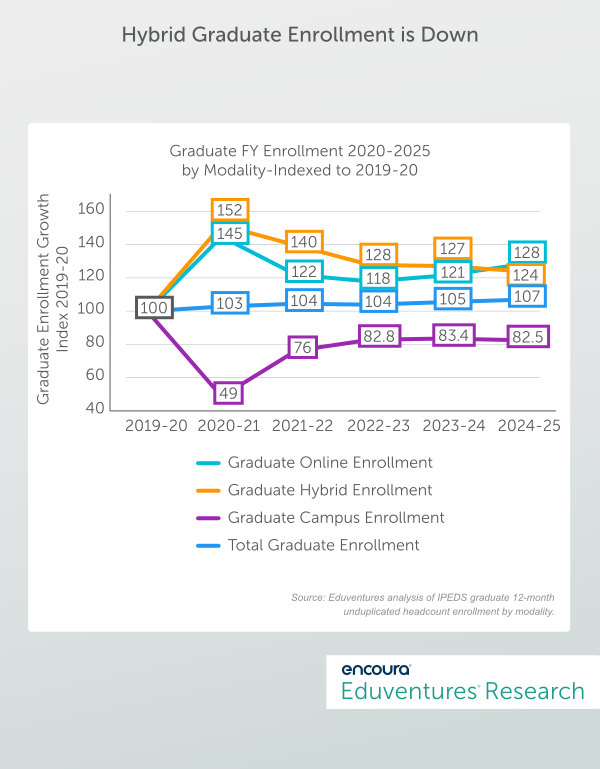
Figure 1.
Campus decline and online growth matched our expectations. Hybrid is the surprise as it was expected to gain traction as a middle ground between campus and online. Instead, it has declined every year since peaking in 2020-21.
That decline may partly reflect how it is defined: students taking at least one online course, but not all online courses. Differences or changes in how institutions classify courses could influence the reported trend. But within that reported decline, a handful of institutions are experiencing extraordinary growth.
Hybrid Winners
Among the 20 largest institutions by hybrid graduate enrollment, five grew over both the past year and in the five years since 2019-20, as shown in Table 1. Together, they added more than 4,000 hybrid students in the latest year, while hybrid enrollment nationally shrank by about 20,000.
Trine University leads with 10,519 hybrid graduate students, while Indiana Wesleyan University (IWU) posted the largest percentage increase (79.3%) among the top 20. St. Francis College grew from about 50 students in 2019-20 to nearly 3,800.
Eye-Popping Hybrid Growth
| Institution | Graduate Hybrid Enrollment 2024-25 | 2023-24 to 2024-25 % Growth | 2019-20 to 2024-25 % Growth |
|---|---|---|---|
Trine University-Regional/Non-Traditional Campuses | 10,519 | 6.3% | 1,866% |
Northeastern University | 6,499 | 6.6% | 200% |
Indiana Wesleyan University-National & Global | 4,683 | 79.3% | 361% |
DePaul University | 4,195 | 2.5% | 37% |
St. Francis College | 3,794 | 32.2% | 7,643% |
All Institutions | 851,471 | -2.3% | 24.2% |
Table 1.
Source: Eduventures analysis of IPEDS graduate 12-month unduplicated headcount enrollment by modality.
These institutions are not pursuing the same strategy. Northeastern has expanded industry-aligned graduate campuses in regional hubs such as Charlotte, Seattle, and Silicon Valley. DePaul’s enrollment appears to reflect its mix of campus and online course options rather than a dedicated hybrid program strategy.
Trine University, Indiana Wesleyan University, and St. Francis College share a common approach: hybrid F-1 graduate programs for international students. Each reported international graduate enrollment growth above 2,000% over the last five years.
Never Miss Your Wake-Up Call
Make informed decisions with the latest higher ed insights from Eduventures Research.
What’s Driving International Graduate Enrollment Growth?
The traditional F-1 pathway combines full-time, primarily campus-based study with the option to apply for Optional Practical Training (OPT) afterward. Curricular Practical Training (CPT) allows eligible students to work as part of their curriculum, typically after one academic year. Graduate programs that require immediate CPT can allow approved work in the first term.
Trine University, Indiana Wesleyan University, and St. Francis College share this model: graduate programs that combine brief required campus residencies each semester with online coursework, while also approving first-term CPT for aligned employment or internships.
Their locations span major metropolitan areas, from Trine’s education centers in Detroit, Phoenix, and outside Washington, D.C., to IWU’s centers near Chicago and Dallas and St. Francis’ Brooklyn campus. All three also use outside recruitment partners to reach international students and support applications.
This hybrid strategy combines metropolitan access, aligned fields of study, work-integrated learning, and specialized recruitment channels to reach students seeking to come to or remain in the U.S. While some students are new arrivals, others are graduates working under OPT who enroll in another degree and may continue related work through CPT. The data cannot distinguish new arrivals from international students already working in the U.S. It also cannot tell us how much of the demand is driven by the academic programs themselves versus the employment opportunities they provide.
It is a different proposition from the hybrid graduate programs traditionally designed for local, domestic working adults. While those programs emphasize flexibility for students balancing education with existing commitments, the international model also provides a pathway to employment in the United States.
That raises an important question: Are students choosing these programs because they prefer hybrid learning or because of the opportunity to combine graduate education with aligned work experience?
A Growth Model Under Pressure
Past gains, however, do not establish a clear opportunity for others today.
The international graduate market is in flux. As a recent Wake-Up Call noted, international enrollment risk is concentrated in certain fields, making stronger domestic demand an important counterweight. Fall 2025 institutional figures also show international enrollment declines at Trine and St. Francis, although each still enrolls thousands of students.
More importantly, the hybrid international model faces regulatory uncertainty. In August 2026, the Department of Homeland Security’s Student and Exchange Visitor Program issued guidance limiting CPT to training required of all students in a degree program, citing concerns about improper authorizations.
Higher education groups sued in October, arguing that the guidance unlawfully restricted internships and bypassed required public comment. Some universities have since paused or restricted CPT approvals, although that does not necessarily mean they have stopped enrolling students.
These developments raise doubts about the sustainability of international hybrid programs whose appeal depends heavily on students' ability to combine study and employment.
For institutions considering similar programs, the lesson is twofold: understanding the regulatory environment and determining whether the underlying student demand can be sustained if access to aligned employment becomes more restricted.
The Bottom Line
For institutions considering hybrid graduate growth, the lesson is to distinguish demand for a delivery format from demand for a specific work-and-study pathway. The extraordinary enrollment gains at these institutions merit attention, but regulatory uncertainty makes replication a risky growth strategy.
More broadly, competitor enrollment growth is not necessarily evidence of a replicable market opportunity. Institutions need to understand not just where enrollment is growing, but why.
