

Last week I shared my opening prediction for higher education in 2026, that the confluence of test-optional undergraduate admissions and a federal push for accreditation reform will convince the Trump administration to impose a two-tier (four-year vs. three-year) bachelor’s degree model.
Now for my second prediction:
- Prediction #2: Another Step-Change for Cross-Border Online Learning
Just as international student enrollment falters, the cross-border online master’s market will get a boost.
Prediction #2: Another Step-Change for Cross-Border Online Learning
When I first got involved with online learning in the late 1990s, what excited (or frightened) higher education leaders was the notion that the technology would enable “anyone, anywhere” to enroll in the “best” universities in the world.
This was naive. For a host of reasons—cost, regulation, complexity, culture—online learning markets have remained fundamentally domestic.
Indeed, international students are still much more likely to endure the travails of visas and airplanes to study overseas than embrace the convenience of online.
The problem for U.S. higher education is that new international student enrollment fell 17% in 2025 (vs. 2024). Federal concern about “hostile actors” mulled restrictions on Optional Practical Training (a work rights pathway for international students) and massively inflated fees for H-1B visas. At the same time, a growing list of countries from which immigrant or non-immigrant travel is banned is making many students and families think twice before applying to American universities. Future enrollment declines are expected.
Could international online come to the rescue? International online enrollment surged during the pandemic and (as with domestic students) settled at a new high (Figure 1).
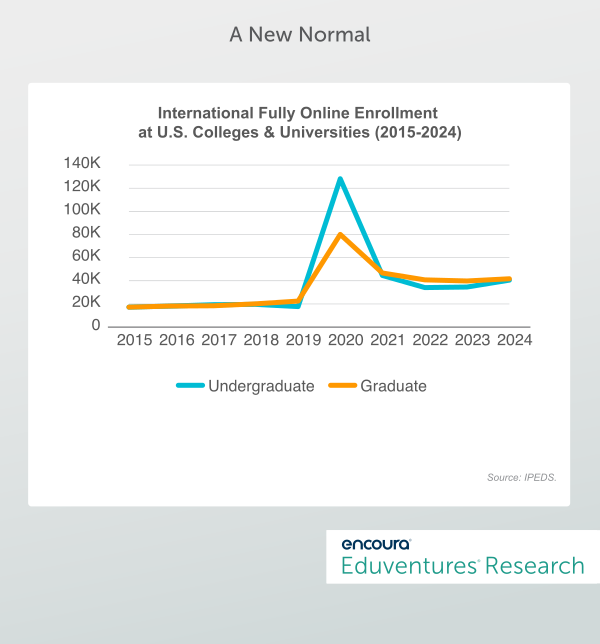
Figure 1.
Pre-pandemic, international online enrollment was below 20,000 (for both undergraduate and graduate students respectively). Post-pandemic, each sector surpassed 40,000.
This is still a fraction of both total international enrollment and total online enrollment.
I predict that international online enrollment will start to pick up again. Yes, driven by the necessity of restricted flows of mobile students to America but also because of burgeoning bachelor’s demand and attainment in countries outside the West.
In 2012, according to UNESCO, there were about 95 million bachelor’s-level students in the “Developing World” (i.e., middle-and-lower-income countries). By 2024, this had jumped to over 150 million, pushed up by both population growth and expanding economies.
Graduate enrollment has kept pace, but the ratio is not growing. In America, the ratio of graduate (master’s and doctoral) enrollment to bachelor’s is close to 30%. In the “Developing World,” it is stuck at about 13%. As countries evolve and bachelor’s attainment increases, the graduate enrollment ratio might be expected to grow as well. But the ratio has barely moved over the past decade. Could cross-border online help?
There is international demand for the right online programs at the right price. Georgia Tech’s outstandingly successful online computer science master’s program reported 7,500 international enrollees in fall 2024. University of Illinois’ similarly low-priced online MBA reported almost 1,000 international students.
High-speed internet access has reached the mainstream among the ever-expanding middle class in many countries. Phones may be the most popular device, but north of 40% of households have a laptop or tablet in countries as wide-ranging as Argentina, Malaysia, Morocco, Saudi Arabia, Brazil, Turkey, and Kazakhstan, according to the International Telecommunications Union (ITU), a U.N. Agency.
Adult undergraduate enrollment is in its infancy in much of the world. Adult learners are much less likely to move abroad to study. Local online options are increasingly common, but a U.S. program might win out on quality and return-on-investment (e.g., employment at foreign multinationals).
Just as the pandemic forced a step-change in international online enrollment, I predict that the second Trump administration will “force” another hike in institutional effort and market interest.
But, how big a hike? I expect that fall 2026 data will show both undergraduate and graduate non-U.S. online enrollment above 50,000 students. That is still tiny compared to mobile student totals and the domestic online market but a significant jump from today’s baseline.
No one is claiming cross-border online learning is an easy win. “International” is not a country, and schools must get specific in terms of countries, programs, pricing, marketing, and local partnerships. But just as domestic higher education is increasingly online, the same will prove true cross-border. And online can strengthen long-term mobile student pipelines and be a component of hybrid programs, too.
By the time I come to review my 2026 predictions (December of this year), the most recent official data will be for fall 2025. This new trend will take a few years to build, but I think we will begin to see evidence for it in the 2025 numbers.
Next week I will review my third and final prediction for 2026…

