

Eduventures has long tracked the “Big Five” fields that dominate student interest — Biology, Business, Computer Science, Engineering, and Health Professions. In 2025, the “Big Five” saw a shake-up: Computer Science lost ground. More notably, early indicators suggest this is not a temporary dip; its tumble from the top appears to be accelerating.
What does this shift signal, and how should institutions respond?
A Break in the “Big Five”
For years, Computer Science has been one of the strongest and fastest-growing academic areas. Even as interest in other fields fluctuated, its position remained stable across both Eduventures’ and National Student Clearinghouse (NSC) datasets — until 2025. Figure 1 examines Computer Science through the enrollment funnel to understand how interest has shifted over the last several years.
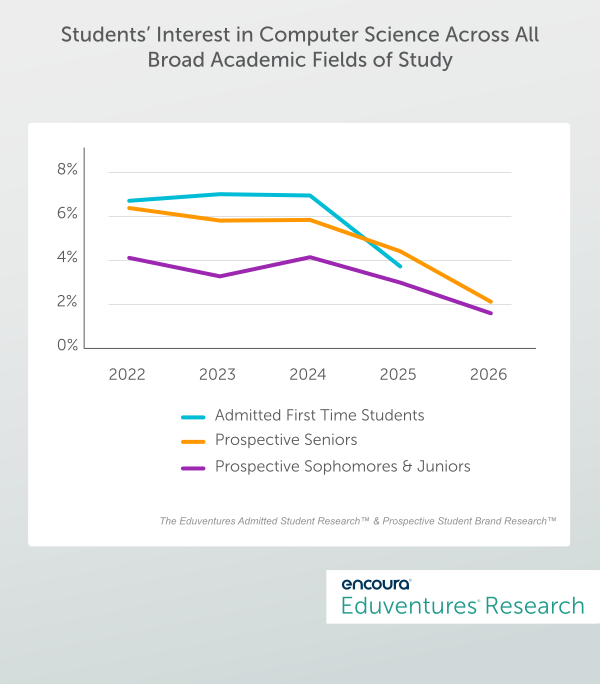
Figure 1.
While Computer Science maintained its rank through fall 2024, according to NSC, it then experienced its first enrollment decline after years of sustained growth (-8%). At the same time, Eduventures enrollment funnel data shows weakening interest upstream — suggesting further declines ahead.
Several forces are contributing to this shift. Headlines about tech layoffs, combined with the rapid rise of AI, have introduced uncertainty into what was once seen as a stable, high-growth field. International enrollment — historically a key driver of Computer Science programs — has also been shaken.
Together, these signals point not to a collapse, but to a market correction.
Softening Interest
Figure 1 shows that declining interest in Computer Science is not just occurring at the point of enrollment; it’s happening much earlier.
Among today’s sophomores, only 1% express interest in Computer Science, a sharp contrast to 4% two years ago. The pipeline is narrowing at every stage of the funnel. Perceptions of instability — driven by automation narratives and industry volatility — may be shaping how students evaluate the field. By the time institutions engage students, fewer are considering Computer Science in the first place.
While recent challenges in international student enrollment contribute to this trend, they do not fully explain it. Eduventures’ most recent data shows declining interest among both international and domestic students. Computer Science now faces a new challenge of cultivating student interest rather than expecting it.
Commitment Through Admission
Given these trends, you might assume some sort of seismic shift among students who initially declared interest in Computer Science, later swapping to another field closer to enrollment. Despite softening interest, however, the Eduventures data suggests that Computer Science still has staying power.
Eduventures data shows that about 66% of all students stick to their original academic interest from the point of being a prospect to being admitted. Which academic areas have the most staying power? Engineering (85%), Business (82%), Education (81%), and, curiously enough, Computer Science (77%).
Perhaps counterintuitively, Computer Science students are not switching majors at the rates some might expect. Further, when looking at the fields students moved into, the apple doesn’t fall far from the tree: these students look to adjacent fields like Engineering or other science-focused disciplines.
Rather than abandoning their interests, Computer Science students recalibrate. This distinction matters. It means that the challenge is less about losing students late in the funnel and more about attracting them early on.
The Bottom Line
Computer Science is losing momentum, not relevance. For an area with such steep growth, the field seemed destined for a recalibration. In an ironic twist, the same forces that fueled Computer Science’s rise are now introducing uncertainty for prospective students. Even so, demand for technical fluency and leadership in this space continues to grow.
For institutions, this creates a strategic imperative:
- Engage prospective students earlier: Interest is forming — and declining — before the traditional recruitment window
- Reframe outcomes: Students need clearer signals that Computer Science pathways remain viable and are evolving
- Broaden the value story: Technical fluency is no longer confined to one major and should be positioned across disciplines
The opportunity is not just to rebuild Computer Science enrollment, but to redefine how institutions present technology’s role in the future of education and work.

