

For more than three decades, the registered nursing (RN) shortage has dominated the healthcare workforce conversation. The American Association of Colleges of Nursing (AACN) reported nearly 268,000 pre-licensure baccalaureate enrollment for 2024-2025, the most ever. After enrollment challenges during and immediately following the pandemic, this market has rebounded strongly.
While the national nursing shortage is still the headline, at the state level, there are significant differences. Some states have strong unmet demand for RNs, while others show signs of a potential workforce surplus.
Is your state producing too few or too many nurses to satisfy workforce demands?
Nursing Enrollment Growth
The Bachelor of Science in Nursing program is often one of the largest and most competitive majors at many institutions. These programs often have enrollment caps and stringent requirements to be admitted to the major. In fact, AACN reported that more than 65,000 qualified applications were turned away from these programs in 2024-25. These programs cited insufficient clinical sites, number of faculty, and classroom space as the leading reasons for turning students away.
Even with these constraints and a global pandemic, enrollment in nursing is still high. In 2015, there were 196,000 pre-licensure BSN students enrolled (Figure 1). In 2024, there were 268,000 — a growth of 37% over these ten years and up 5% from the previous year.
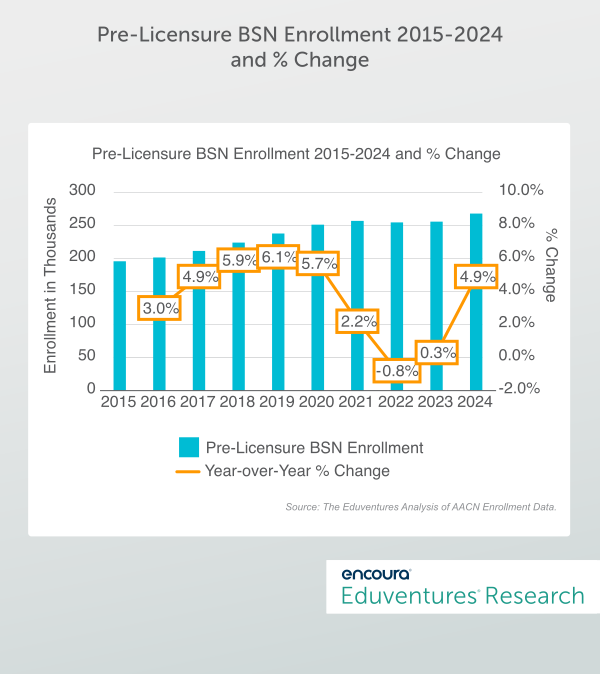
Figure 1. Source: The Eduventures analysis of AACN data.
Year-over-year enrollment growth was strong pre-pandemic, growing by 5% to 6% annually. But the market plateaued between 2020 and 2023, with a rare decline in enrollment between 2021 and 2022. The market has seemingly gotten back to pre-pandemic growth. At the same time, the associate degree route has had modest growth as the industry has pushed for higher bachelor’s degree attainment. Recent data suggests 54% to 62% of the RN workforce have a bachelor’s degree.
Nursing Shortage?
The national RN workforce is 3.4 million strong and is expected to grow 6% in the next five years. This growth equates to 210,000 projected annual openings.
The National Council of State Boards of Nursing (NCSBN) reports the number of students that take and pass the NCLEX-RN, the national test to become a registered nurse. In 2025, there were nearly 190,000 U.S. educated students that passed the test, with another 37,000 that were internationally educated. The result is that in 2025 there were 227,000 new nurses nationally.
This suggests that, nationally, there is a nursing surplus (227,000 new nurses vs. 210,000 annual openings). But this national view hides sharp differences by state.
State Supply and Demand for RNs
Using Lightcast location quotient metrics, we use RN employment concentration as a proxy for workforce supply and job posting concentration as a proxy for employer demand, each benchmarked to a U.S. value of 1.0. If a state’s employment concentration is 1.2, then it has 20% more RNs than would be expected.
Table 1 highlights selected states above and below 1.00 on these measures, but the most telling signal is the gap between employment and posting concentrations. Taken together, these states illustrate three distinct RN market types: strong unmet demand, balanced markets, and workforce surpluses.
For example, New Hampshire and Oklahoma show strong unmet demand, with job posting concentrations (1.63 and 1.33) far exceeding employment concentrations (1.14 and 0.90). This signals significant hiring needs and prime opportunities for RN program expansion despite solid or below-average existing workforces.
| State | RN Employment Concentration | RN Job Posting Concentration | Employment & Job Posting Gap | Category |
|---|---|---|---|---|
United States | 1.00 | 1.00 | 0.00 | Benchmark |
New Hampshire | 1.14 | 1.63 | -0.49 | Strong Unmet Demand |
Oklahoma | 0.90 | 1.33 | -0.42 | Strong Unmet Demand |
Massachusetts | 1.16 | 1.13 | +0.03 | Balanced Market |
Idaho | 0.81 | 0.85 | -0.04 | Balanced Market |
Pennsylvania | 1.15 | 0.84 | +0.31 | Workforce Surplus |
Utah | 0.70 | 0.42 | +0.28 | Workforce Surplus |
Table 1. Source: The Eduventures analysis of Lightcast data.
Massachusetts and Idaho represent balanced markets, where employment and postings closely align (gaps of +0.03 and -0.04), indicating stable RN labor dynamics with matched supply and demand, which is ideal for steady enrollment without high growth or saturation risks.
Pennsylvania and Utah exhibit workforce surpluses, as employment concentrations (1.15 and 0.70) outpace postings (0.84 and 0.42), suggesting ample RNs relative to hiring signals, low turnover, and potential cause for concern among RN programs amid stable-to-weak demand.
It is important to note that states can have higher or lower RN employment concentration for many reasons: dense hospital and academic medical center footprints, older populations, higher chronic disease burdens, stronger wages and working conditions that attract nurses, and substitution of RNs for LPN/LVNs in care models. Understanding which of these forces are prominent in your state is essential context for interpreting whether high RN concentration reflects a genuine surplus, a strategic strength, or both.
Bottom Line
Nationally, bachelor’s‑level nursing looks like a success story: record pre‑licensure enrollment, a strong NCLEX pipeline, and more new RNs in 2025 than projected annual openings.
But at the state level, the picture is more complicated with some markets facing acute RN hiring gaps, while others are drifting toward oversaturation. A real risk in oversaturated states is graduates not finding work readily and potentially stagnant or declining salaries.
Several nontraditional providers are seeing the opportunity across states as they grow online and hybrid prelicensure BSN programs. These programs decouple didactic instruction from local campuses while preserving in-person labs and clinicals.
- Chamberlain University’s BSN Online Option is available in 35 states with clinical rotations in 20 states.
- Western Governors University's Online BSN recruits students in 25 states and has regional lab experiences and partnerships with healthcare employers.
- Nightingale College’s online BSN program is national (49 states) with clinical site approval in 20+ states.
These providers are filling the gap in places where states and institutions have not increased enrollment capacity. While these institutions are targeting a different type of student, there is a danger that these programs could eat away enrollment at institutions that serve more diverse populations.
Ultimately, it will be critical for institutions to understand the labor market that graduates are entering. In a world where “nursing shortage” headlines persist but local realities diverge, institutions that calibrate programs to their regional RN labor market will better serve students, employers, and their state’s healthcare system.
