
Media coverage of the new Programme for International Student Assessment (PISA) scores — the international test of literacy, math, and science taken by 15-year-olds — makes for depressing reading. Global averages in all three areas have trended downward since 2012, with marked drops this decade. The U.S. slipped in math and, to quote The New York Times, “plummeted” in reading.
Social media, smartphones, AI, and pandemic fallout are among the alleged culprits.
At the same time, American colleges and universities are beginning to descend the “Demographic Cliff” of fewer high school graduates. Is the route now doubly treacherous due to sagging college preparedness?
But declining test scores don't necessarily mean declining student capabilities. For higher education, the more important question may be whether institutions are adapting quickly enough to a changing generation of students.
Plummeting PISA?
Figure 1 shows the Organisation for Economic Co-operation and Development (OECD) — the rich country group at the heart of PISA — and U.S. PISA averages for reading and math between 2003 and 2025. The OECD scores are for a constant 23 countries. In 2025, over 760,000 15-year-olds in 91 countries took the PISA test, representing 33 million 15-year-olds globally.
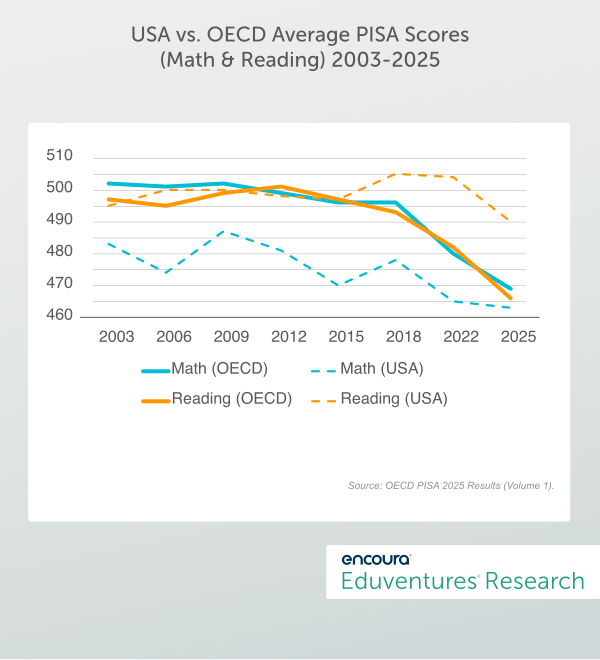
Figure 1.
The United States was average in reading through 2015 before moving ahead. Our nation slumped in 2025, but the OECD average did worse still. In math, American students have consistently lagged the benchmark. By 2025, both the U.S. and the OECD cratered to a neighborly all-time-low.
The PISA math test focuses on basic arithmetic, algebra, geometry, and statistics. Questions present real-world scenarios and a mix of multiple choice and open-ended problems.
The reading assessment gauges the ability to locate, understand, and evaluate written information. Questions probe source material perspective and reliability and span multiple types of text and visuals. Test takers earn higher scores if they answer more difficult questions correctly.
In 2025, the best performers in math were four Chinese provinces that averaged in the low 600s. Singapore topped the list in reading (535), with the Chinese cohort a close second. The worst performing countries are in the mid-300s. But let’s not get carried away. The U.S. reading score is only 1% below the nation’s result in 2003. Even the 2025 U.S. math score is only a few percentage points below the benchmark of two decades ago. And the American test scores for science — crowded out in doomsday domestic coverage — went up slightly compared to 2022 and remain well-above the OECD average.
Make It Make Sense
The PISA results are the latest addition to a confusing set of signals about college readiness in America.
Positive Signals
- The high school graduation rate keeps climbing. At close to 90%, far more students complete high school than they used to (79% in 2011 according to the National Center for Education Statistics (NCES)).
- The number of high school graduates hit a record high. In 2024, 3.2 million seniors graduated high school, surpassing the previous high in 2018.
Negative Signals
- The college-going rate is depressed. In 2023, only 61% of recent high school graduates enrolled in college, the lowest rate since 1990, according to NCES. The rate has edged up since but is still about 5 percentage points below the pre-COVID benchmark.
- Standardized test scores are down. Average SAT Math and English scores are about 4% lower than a decade ago, and typical ACT scores are 9% lower. This is despite a 9% fall in total SAT/ACT test takers.
A superior high school graduation rate and a record number of graduates are difficult to square with a depressed college-going rate and lackluster standardized test scores. Are rising graduation rates masking gaps in academic preparation? Or are high schoolers prepared for college but opting out?
PISA Problems
But there is something odd about relying on testing methods common 50 years ago — abstract questions in a timebound setting — to judge student capability in today’s world.
The staying power of “test optional” for college admissions rests on a widespread belief that high-stakes testing is suboptimal when trying to assess something as complex and qualitative as student readiness. At the same time, rampant allegations of grade inflation cry out for an “objective” test of true ability.
The PISA 2025 administration in America also ran into problems. The OECD was unable to secure an adequate sample of either students or schools, and no state generated a cohort large enough to permit state-specific scores (as in PISA’s past). Sizeable standard error bars are placed on the data in the U.S. County Report, with the OECD noting that it cannot say whether national averages might be substantially better or substantially worse.
It is easy to imagine state governors on the left and right being of two minds about whether to permit this “globalist” organization to subject its young people to this suspect instrument.
Standardized tests like PISA have the advantage of simplicity and consistency but seem increasingly out-of-step in an era of mental health crises, “whole person” equity assessments, and AI tools that can ace such tests in seconds. And because PISA has no real consequences for students, it’s possible that some made little effort.
Different Students, Different Colleges?
For colleges and universities, these tests results could signal that students' academic skills may not be what they once were. But in the age of smartphones and AI, the nature of knowledge has changed.
It is easy for older folks to see simple degeneration, but history tells us that reordering and adaptation are taking place. Perhaps today’s students are different, not necessarily better or worse.
Institutions, too, are under pressure to adapt. The legacy college experience stands accused of being too much like PISA: too abstract, too disconnected from real-world application, and lacking the sort of coherence and meaning that motivates effort and fosters true ability.
Institutions are torn between doubling down on the rigor of the liberal arts and making the student experience as convenient, supported, and painless as possible. According to IPEDS, per-student spend on “Student Services” at public four-year institutions grew 25% between 2019 and 2024 — faster than inflation — but retention and completion rates did not rise commensurately.
That doesn't mean the additional support isn't helping. But neither approach, on its own, is enough to meet the moment.
Colleges and universities suddenly look like precious communal spaces in a world of atomized consumption, homeworking, and emotional support chatbots. The opportunity for higher education leaders is to take full advantage: to lean into groupwork projects in class, living-learning communities, and faculty mentorship.
But schools also need to lean out: using online learning to enable students to complete internships off-campus and keep up with their courseload; and bringing employers to campus to co-sponsor maker spaces and problem-solving competitions. Recent press coverage of examples from institutions as diverse as University of Michigan and Central New Mexico Community College make the point.
There are difficult choices ahead for policymakers, such as how much to invest in apprenticeships at the expense of degrees, and whether the trend for reduced credit bachelor programs can deliver both reduced costs and a meaningful college experience. But these questions create opportunities for institutions to rethink the capabilities students have and the experiences they need.
The Bottom Line
Students may be getting “less smart” if judged by traditional measures like PISA, but they are smart enough to know that the world is changing around them — and that the college experience needs to adapt.
For higher education leaders, the best way to scale safely down the Demographic Cliff is to embrace a changing student population by renewing the essence of college for a new era. Get that right, and students, families, governments, donors, and employers will pay for the privilege.
Interested in academic program evaluation and student experience innovation support? Please contact your Client Research Analyst.
