

A new study about AI in higher education revealed that 42% of bachelor’s degree students have reconsidered their major due to the impact AI might have on the job market and 13% have already switched.
Headlines in the news offer two competing narratives: One type warns that AI is gutting jobs across the economy, while the other argues it is fueling a new wave of opportunities.
With AI even drawing boos during commencement speeches, it’s fair to ask: Is AI revolutionizing the labor market — or simply accelerating changes already underway?
The evidence increasingly points to evolution rather than revolution. AI is changing the work people do, the skills employers expect, and the way organizations hire much faster than it is eliminating jobs altogether.
The Student Perspective
The Lumina Gallup report indicates that technology majors were most likely to reconsider or change their major, while students majoring in natural sciences, healthcare, social sciences, and the humanities were among the least likely.
These patterns reveal where students perceive AI’s impact to be the greatest. Healthcare still requires physical presence, clinical judgment, and licensure. Natural sciences depend on fieldwork and deep domain expertise. Humanities and social sciences emphasize interpretation, ethics, and human context — areas where AI can assist but still struggles to replace human judgement.
Students' instincts largely align with what we're seeing in the labor market. AI’s impact is less apocalyptic than many headlines suggest, but considerably more complicated. AI is reshaping tasks, skills, and hiring faster than it is culling jobs at scale.
To understand this tension, let’s look at AI-related job cuts.
AI Is Eliminating Jobs
The research firm Challenger, Gray, and Christmas reported nearly 444,000 job cuts through the first half of 2026. While job cuts are down in 2026 compared to this time last year, AI is now cited as a prominent factor. Prior year job cuts were driven by store/unit closures, market conditions, and restructuring.
Figure 1 shows annual job cuts attributed to AI since 2023.
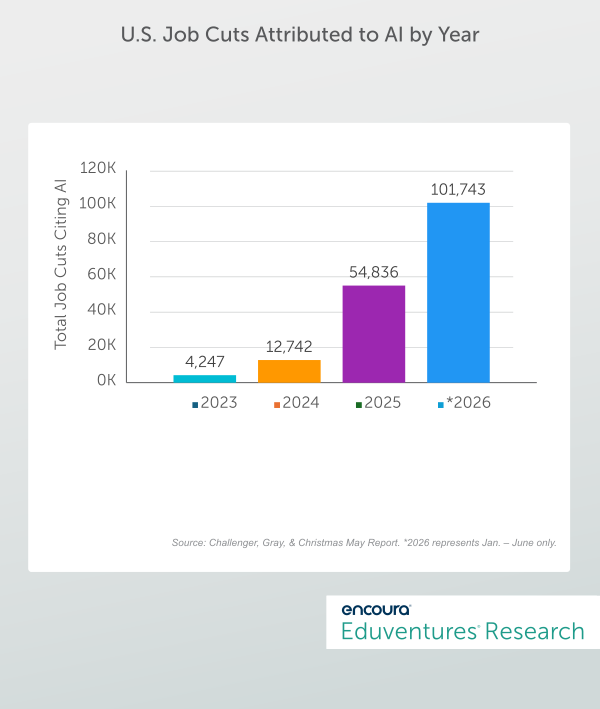
Figure 1.
AI led the way among all reasons for job cuts for the fourth month in a row amounting to 23% of all 2026 job cuts. After six months of 2026 reporting, AI-attributed cuts have already surpassed last year’s full-year total.
But this is not the first technology to disrupt the economy. Personal computers, the internet, and smart phones all ushered in new waves of innovation, new companies, and new roles. AI appears to be the next evolution in our labor market — one where disruption and creation move together, generating new roles even as it drives job cuts.
AI Is Creating Jobs
According to LinkedIn, slow hiring is more related to economic uncertainty and monetary policy shifts than AI disruption. Employers have created at least 1.3 million new AI-related jobs including data annotators, AI engineers, and forward-deployed engineers. Meanwhile, a Strada Institute report suggests that deeper AI adoption correlates with job creation, not elimination.
Job postings indicate that the skill “Artificial Intelligence” has grown over 700% in job postings in the last two years (compared to 16% across all job postings). In May 2026 alone, there were 191,000 job postings requesting AI as a skill, nearly 100,000 more than earlier this year, comprising about 5% of all job postings.
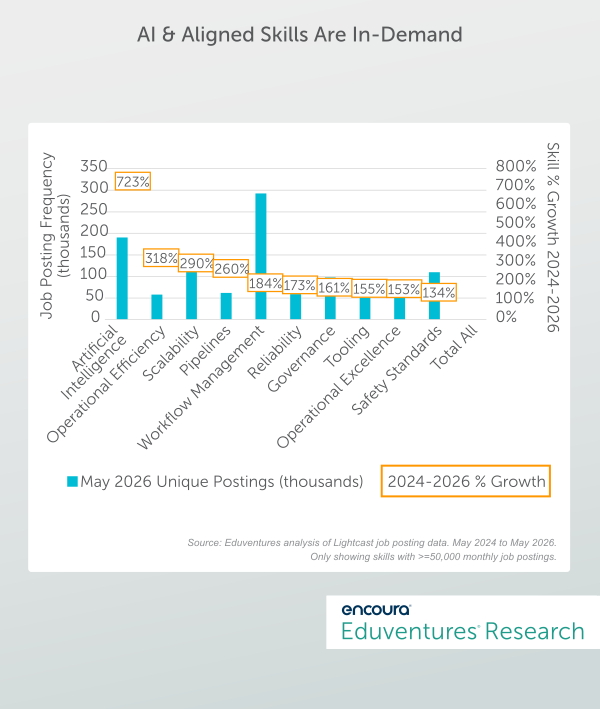
Figure 2.
Many of the other booming skills shown in Figure 2 are related to AI. “Tooling” and “Pipelines” reflect the build and deployment side of AI model workflows. “Workflow Management,” the most in-demand skill in the dataset, reflects where employers are trying to operationalize AI without disrupting existing processes. This leads to “Operational Efficiency” and “Operational Excellence,” two related skills that AI is positioned to improve.
Additionally, a new report from Bain and Company suggests that AI is under-delivering as a cost saver. Nearly 40% of firms surveyed had cost reductions of up to 10% and were below expectations. These companies, however, are still investing: 90% indicated they are increasing their AI budgets. The top barriers to cost savings are ones that higher education knows well: fragmented data systems and a shortage of employees with the right skills.
The Bottom Line
Generative AI has reached 53% of population-level adoption within three years, faster than the PC or the internet. But the labor market impact is slower and more uneven than headlines suggest.
Students are reacting to labor market uncertainty by rethinking majors based on future AI implications. But the AI revolution, a mass culling of jobs, has not (yet) materialized.
Job cuts are increasingly being framed as part of AI and automation strategies as employers need resources to fund expanding AI initiatives. These same employers are simultaneously posting record demand for AI-ready employees.
Institutions cannot wait for the labor market to settle before responding. These priorities stand out:
Standardize AI literacy. More than half of undergraduates say they use AI daily or weekly, but nearly 30% say their institution is not providing enough training.
- Programs should set clear expectations for responsible use, quality control, and authentic work, moving beyond bans and one‑off guidance.
Highlight the human advantage. Healthcare, natural sciences, social sciences, and the humanities already lean into areas where AI struggles: physical practice, interpretation, ethics, and human context.
- Institutions should highlight what students learn that cannot be automated: critical thinking, communication, and ethical judgment.
Use AI to fix bottlenecks. Most campuses face the same AI barriers as corporations: fragmented systems, weak integration, and poor governance. EDUCAUSE reports that only 13% of institutions are measuring ROI on AI tools, meaning most campuses lack a feedback loop.
- AI‑enabled advising, outreach, and analytics will only deliver if institutions also tackle data quality, workflow redesign, and staff upskilling.
The evidence points to transformation, not elimination. Like the internet before it, AI will reshape work in ways no one fully predicts. Institutions that act now will be better positioned to help students land on the right side of that shift.
