

One certainty about higher education in 2025—attempted cuts to federal research funding, the halving of the U.S. Department of Education, and the Trump administration’s very public feuds with elite universities—is that outlandish predictions now seem more plausible. This is unlikely to be a quiet year.
My predictions for 2026 speak to growing tensions in our sector around student access and admission standards, international student demand, and higher education technology versus labor.
For this Wake-Up Call, we will focus on my first prediction, with two more to follow next week.
Prediction 1: Admissions Backlash and a New Kind of Bachelor’s Degree
An incredible shift took place in traditional-aged undergraduate admissions over the past few years: the number of institutions requiring a standardized test dropped from over 1,000 in 2019 to fewer than 100 today. Debate about the fairness or accuracy of the SAT and ACT as predictors of college success is not new, and there was a slow but steady move to “test-optional” during the 2000s and 2010s, but test requirements collapsed in 2020 and 2021 (Figure 1).
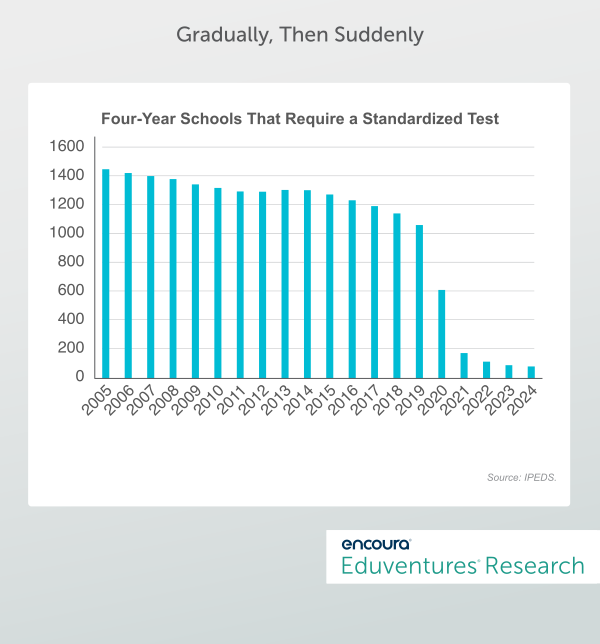
Figure 1.
Of course, disrupted testing logistics and uncertain student enrollment during the pandemic, plus the “racial reckoning” spurred by the murder of George Floyd, drove the flood to test-optional. But post-pandemic (and post-race-based affirmative action following SFFA vs. Harvard), test-optional continues to gain ground. Why?
The obvious reason is softening student demand and the looming “Demographic Cliff.” In today’s tough enrollment environment, most schools want to signal accessibility. According to IPEDS’ most recent data, 1,056 four-year schools are test-optional and another 744 are “test-blind” (meaning that standardized test results are not considered at all). Only 85 require a standardized test.
A much-covered recent report from the University of California San Diego (one of the California system’s more selective schools) portrayed the test-optional surge as “very troubling” for academic standards. Lack of demand is not a problem for the likes of UC San Diego or other public flagships. For these schools, test-optional is a way to address access and equity concerns.
The UC San Diego report found that one in eight enrolled students needed remedial math and one out of 10 struggled with middle school material, far higher than usual. Serious decline was also cited in language and reasoning ability. School resources are strained, and students are not well-served, according to the report.
The report’s authors recommend stricter admission criteria for math-heavy majors, ramped up summer remediation classes so students are ready for fall, and collaboration with high schools where GPA and student ability are most misaligned.
The UC San Diego situation is unlikely to be the exception. Such dramatic changes to national admission norms must have downstream effects.
Selective schools that do not use standardized tests get a pass on access but must find other ways to demonstrate rigor. Other institutions are in a bind between returning to more conventional admission criteria and softening demand, and between failing weaker students versus keeping graduation rates artificially high.
But this is not just a matter for institutions to figure out. The current federal administration (not known for sitting on the sidelines) has an opinion.
Enter Accreditation Reform
In October, the White House made standardized tests one of the conditions of its (widely rejected) “Compact for Academic Excellence in Higher Education.” The administration sees testing as the best way to ensure academic rigor and as another means to banish much-maligned DEI conceptions of merit. A new federal directive demands that elite schools hand over troves of data to “prove” that admission is based on academic merit only.
I anticipate that in 2026 the Trump administration will double-down on linking federal funds to standardized tests. There is no statutory authority to do this. The Higher Education Act (HEA) does not mention admission criteria for colleges (beyond the baseline of a high school diploma or equivalent). But I see an opening.
The HEA (Section 496 (a)(5)(G) requires recognized accreditors to assess institutions’ “recruiting and admissions practices.” Accreditors today have policies on admissions transparency and fairness but leave the details to institutions.
The Trump administration has signaled that accreditation reform is on the agenda this year, and I doubt the intervention will be a light touch.
The Obama administration used reference in the HEA in preparing students for “gainful employment” as a criterion to admit for-profit and non-degree programs to federal student aid as the kernel for ambitious “Gainful Employment” regulations (leading to today’s “Do No Harm” graduate earnings criteria for programs at nonprofit and for-profit schools). I foresee the Trump administration using the “admissions practices” HEA language as a pretext to insist that institutional accreditors “toughen” their standards by requiring colleges use some kind of standardized test for undergraduate entry.
My Prediction: A New Kind of Bachelor’s Degree
So where does the new kind of bachelor’s degree come in?
It does not make sense to require all schools and programs to use a standardized test. Many colleges and universities are minimally selective or open admission. The Trump administration’s priority is to ensure “rigor” in admission to selective institutions.
This logic—and seeing a bigger reform opportunity—will convince the government to make a distinction between bachelor programs that require testing and those that do not. In short, the Trump administration will latch on to nascent interest in reduced-credit bachelor’s degrees to forge a two-tier system:
- Four-year degrees for students who aspire to graduate or attend professional schools
- Three-year degrees focused on workforce entry
Standardized tests will be required for entry to four-year degrees only.
The rationale for three-year degrees will be to boost lackluster bachelor’s completion rates at many schools, lower student debt, and force a system-level credential redesign that the sector could never manage alone. General Education will be pared back or eliminated for three-year programs in favor of the major, work experience, and job-aligned skills development.
A school might offer both four- and three-year degrees, even in the same discipline. This will allow flagship public institutions to continue to emphasize both selectivity and community access. Two types of bachelor’s degrees will make the balancing act less strained, offering a way for students to be “college-ready” and schools to be “study-ready.”
A three-year degree graduate could have the option to transfer into the final year of a four-year program. (Of course, institutional accreditors will be “required” to revise their standards to accommodate a two-tier bachelor model.)
The Bottom Line
There are reasons to dislike my predictions. Student diversity will suffer in programs that require testing. There is evidence that less prepared students admitted to stronger schools benefit more than by attending less selective institutions. Pandemic-induced “learning loss” (as much as test-optional) may be fueling frustrations at the likes of UC San Diego. Mishandled, three-year degrees might end up preparing students for yesterday’s jobs.
Would the two types of bachelor’s degrees be roughly balanced in terms of enrollment numbers, or would one outpace the other? How would schools decide on program length? Market forces will reveal a lot, and the Trump administration may tip the scales by altering loan limits to steer demand in a direction to its liking (perhaps toward shorter programs).
What is not in question is that unprecedented pressure is building for change—with the extra volatility of a president willing to blow up the status quo. The surge of test-optional may have addressed some problems, but it is creating new ones. Standardized tests may not be the perfect gauge of anything, but schools have not produced a crisp alternative, and today’s federal government has no patience for “holistic” admissions.
It would be an intriguing twist to the test-optional tale if the sidelining of testing in the cause of equity led to federal insistence on testing and a two-tier bachelor’s degree. I see the confluence of motivation, mechanism, and disregard for precedent to make it happen.

