
2026 Digital Marketing Trends for Higher Education
Go to Content


AI-Powered, Always-On Personalization
Deliver real-time relevance using predictive insights and AI-supported engagement that feels authentically human.

Experience-Driven Omnichannel Engagement
Create connected, memorable touchpoints across channels to guide students confidently through their journeys.
The digital enrollment landscape is evolving faster than ever and so are students’ expectations. As search behavior fragments, AI reshapes communication, and marketing budgets face greater scrutiny, institutions must navigate a more complex and competitive environment. This year’s Digital Marketing Trends for Higher Education Action Plan highlights the five trends shaping how students and their families will discover, evaluate, and choose their institutions in 2026 and in the following several years.
Rooted in Encoura’s research-backed insights and full-funnel expertise, each chapter offers practical, future-ready guidance to help connect more meaningfully with the students and families you hope to serve.
 Trend 1
Search Everywhere Optimization
College search no longer has a single starting point. Students follow countless paths from social platforms and mobile queries to AI assistants and peer-generated content – often before ever reaching your website. Institutions must prepare for a world where discovery happens everywhere, and brand visibility must follow.
As discovery becomes more distributed, institutions that ensure their content is structured, consistent, and findable across all of these touchpoints will be a step ahead.
What’s Changing
Search strategies are evolving to include SEO, GEO, and AEO.
Institutions must now optimize for traditional search (SEO), generative AI (GEO), and instant answers (AEO) to stay visible.
SEO - Search Engine Optimization
What It Focuses On
Optimizing website content to rank in traditional search engine results.
Why It Matters In 2026
Foundational – controls how your site appears in already trusted search results.
How Students Experience It
Students see your pages appear in classic organic search listings.
Higher Ed Example
Your “Nursing Program” page ranks highly for “nursing degree requirements.”
GEO - Generative Engine Optimization
What It Focuses On
Structuring content so generative AI search tools — ChatGPT, Gemini, Copilot — can understand, cite, and surface your information.
Why It Matters In 2026
As AI search becomes a primary discovery channel, GEO ensures your institution is visible, accurate, and recommended inside AI responses.
How Students Experience It
Students encounter your institution in AI-generated answers — often before they click your website.
Higher Ed Example
ChatGPT Search includes your cybersecurity program as a cited source when a student asks, “Best cybersecurity programs in the Midwest?”
AEO - Answer Engine Optimization
What It Focuses On
Creating concise, structured content that answer engines — Google AI Overview, featured snippets, voice assistants, and short-form platforms — can easily surface.
Why It Matters In 2026
Zero-click search is accelerating. AEO ensures the information pulled into these instant answers is accurate and reflects your institution's interests.
How Students Experience It
Students receive fast, summarized answers — Google, Siri, Alexa, TikTok, YouTube Shorts, or in AI Overviews — without needing to dig through long pages.
Higher Ed Example
When a student asks Siri, “What programs are best for adult learners?” the assistant pulls a concise summary of your evening or hybrid programs directly from your structured content.
Want to learn more about how students are searching for colleges and programs? Check out this quick Encoura Digital Enrollminute video:
Search Everywhere Optimization: How Students Find You in 2026
AI-powered search is reshaping how students find information.
AI overviews and generative search tools now summarize answers instantly, often replacing traditional organic results. Students skim AI-provided context before deciding whether to click deeper. Institutions must ensure their content is structured and clear enough to be surfaced in these new formats.
Social platforms are primary search engines.
Students use social platforms as search engines for programs, culture, and affordability questions. TikTok, Reddit, and YouTube have become the starting points for “What’s campus life really like?” Students trust authentic demonstrations, not polished pages. That means institutions need searchable social content — tagged, captioned, student-driven — to show up naturally in platform-native discovery.
Local and mobile-first search drives early exploration.
Students increasingly search “colleges near me,” “local nursing programs,” or “universities with night classes,” especially on mobile devices. Mobile-first structure, reliably updated program pages, and regionally optimized content help institutions appear more prominently in the places where these intent-driven searches occur.
Search behavior is fragmented across devices and contexts.
Students bounce between their phones and laptops, searching in moments of curiosity, stress, or excitement. Mobile-first content is shaping early impressions and influencing exploration behavior. Institutions must maintain clear, consistent messaging so each interaction reinforces the next, regardless of channel or platform.
Why It Matters
Our research shows that for most prospective students — both undergraduate and graduate — the search journey still begins in one familiar place: a search engine. Even as AI assistants, voice search, and social discovery grow in influence, students overwhelmingly rely on search as the first point of exploration.
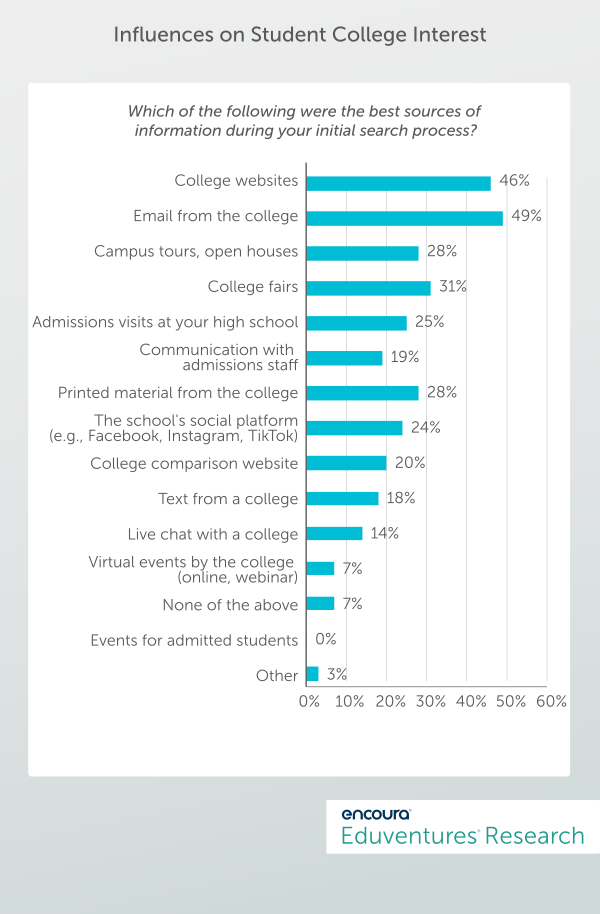
Unless you have directly emailed a student, high schoolers are most likely to end up at your college website by first using a search engine (Source: Eduventures Student Sentiment Research 2025). In addition, drawing from our 2025 E-Expectations Trend Report, we found that 11% of students used AI tools to find a particular college.
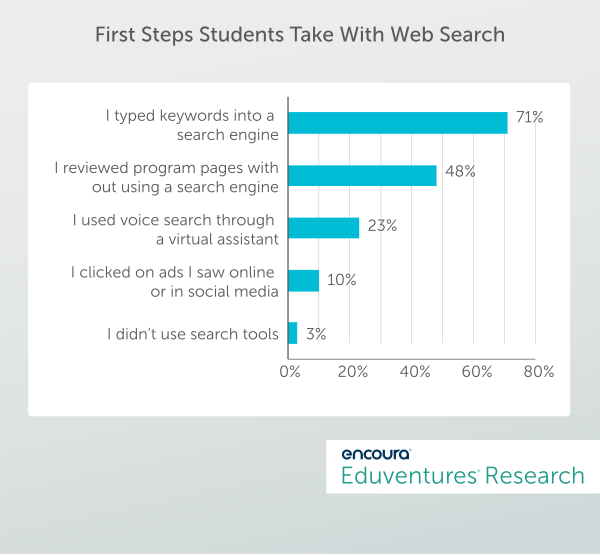
Prospective graduate students go to search engines to begin their college searches. Source: RNL 2025 Graduate Student Recruitment Report
What prospects find in those early moments — program pages, affordability guidance, signals of flexibility, or career outcomes — shapes which institutions feel relevant and worth pursuing.
Voice queries and AI-generated summaries now add new layers to this behavior, influencing perception before a student ever reaches your website.
This expanding landscape means visibility alone is no longer enough; institutions must show up clearly, consistently, and in formats both humans and AI systems can interpret. Strong SEO, high-impact program content, and a presence that reinforces your brand across organic and paid channels all work together to make your institution discoverable in meaningful ways. As these pathways continue to evolve, institutions will need a search strategy built for where students are actually starting — not where they used to start.
What Institutions Should Do Now
Students form opinions quickly, often on platforms that institutions do not control. To remain discoverable across this landscape, colleges should treat search as an ecosystem rather than a tactic. This means optimizing not only the institutional website, but also the content, structure, and presence that influence how your institution appears across AI-driven responses, social search results, and mobile queries.
Start by assessing where your prospective students begin their search journeys. Look at top-performing pages, high-exit pages, and common student questions. Identify gaps where your institution’s answers are unclear, outdated, or buried. From there, build a plan that ensures core content, such as program descriptions, affordability, student life, and outcomes, is structured, tagged, and easy for both humans and AI systems to interpret.
Actionable Steps:
- Audit your AI search readiness by reviewing how your top pages appear in AI-generated summaries.
- Strengthen local presence with optimized Google Business Profiles and program-level metadata.
- Refresh program pages annually to improve accuracy, clarity, and structured data markup.
- Treat social as a discovery channel by tagging content clearly and publishing searchable, student-centered videos.
- Develop unified message pillars to ensure your institution’s story is consistent across channels.
Encoura POV
As search becomes more fragmented, students’ pathways to discovery grow increasingly complex. Encoura helps institutions understand where students actually begin their journeys and how to strengthen visibility across emerging AI-driven and mobile-first search environments. Our behavioral insights guide partners to show up clearly wherever students are looking — creating more informed, confident exploration from the very first touch.

Get Our Four Additional 2025 Digital Trends
Fill out the form below to receive the entire action plan, which covers four additional trends to consider as we engage students and families in 2026. Also included is a checklist to help your team get started with implementing these trends at your institution.
